The Story Behind the Book

Polygamy.[1] This word often conjures up negative thoughts, images, and stories told throughout the years. The Western world most likely identifies polygamy with Mormonism and the tragedies therein. It seems as though these tragedies have defined what polygamy is all about, but is this generalization really fair? Before you misunderstand me, I am NOT (nor ever have been) a Mormon nor do I agree with the tenets of Mormonism. Rather, my interest in polygamy derives from my love of missions.

Because of the negativity surrounding polygamy in the Western world, people’s perceptions and feelings often get inserted into Scriptural depictions of polygamy. Growing up in the church, I was taught that God simply tolerated polygamy practiced by the biblical patriarchs. This “toleration” led me to believe that polygamy was indeed a sin, but for some reason God just let it go. The impression I got from this teaching was that these patriarchs were righteous men who happened to make mistakes along the way. But one question remained in my heart: Does God really tolerate sin to the point of not saying ANYTHING? It wasn’t until much later that I reevaluated this thought process.

I started participating in short-term mission trips around 11 years old. In the following years, my passion and heart grew for missions as I traveled to Hungary, Romania, Thailand, Peru, and South Africa. I met amazing people who had a heart and hunger for the truth. I pursued a degree in Intercultural Studies because it has been God’s desire for me to be a missionary. In learning how to approach another culture and teach the Gospel, the subject of polygamy would come up from time to time. I wrestled with the question, What would I do? Can I justify teaching people to split up their families because they’re in sin? On the flip side, can I live with teaching people how to live a Christian life while still living in sin? It seemed like there was no good outcome to either of these questions. As soon as I would ponder this dilemma, I pushed it off and moved onto something else. It wasn’t until I was sitting in a Cultural Anthropology class during my undergraduate studies that I was confronted with these same questions.

My professor must have been talking about different family structures one day (I don’t exactly remember), and he commented that he didn’t think Scripture teaches against polygamy. I had never heard anyone say this before. This went completely against what I had been taught, and I questioned him, What about this Scripture? What about that Scripture? He gave me some responses, but he didn’t have much to say. He mainly was just giving the class his opinion. Within this discussion he commented how polygamous families coming to America were often forced to divorce because of our laws, and my professor didn’t agree with that. He also shared one story in particular that caught my attention.

Years ago his parents were missionaries in Western Africa. His parents were planting a new church and needed funding for a new building. A polygamist offered to pay for the project (polygamists tend to have more wealth which they need to take care of their larger families), and apparently my professor’s parents agreed. However, when it came time for services to begin, the missionaries wouldn’t allow the polygamist to participate unless he was no longer a polygamist. As I listened, I could tell that my professor was not pleased with his parents’ decision, and I began to wonder a few things myself. Why did they offer to let the man pay the expenses if they didn’t agree with his lifestyle? Because they accepted his money, how could they justify excluding him from the body? What kind of message did this send to the rest of the village? How could they encourage divorce in order to participate in the body of Christ? At this point, I couldn’t let the polygamy dilemma go. There had to be a biblical course of action.

I decided to take a fresh look at Scripture again and found that there is, indeed, no prohibition of polygamy. There are regulations concerning polygamy in the Law, and there are a number of narratives involving polygamy, but there is no prohibition. On the contrary, there are a few passages that seem to indicate God’s involvement rather than a simple toleration. For example, in 2 Samuel 12 Nathan confronts David about his sins of adultery and murder. Pay attention to what the Lord says through Nathan in vv. 7-8, “Nathan then said to David, “You are the man! Thus says the Lord God of Israel, ‘It is I who anointed you king over Israel and it is I who delivered you from the hand of Saul. I also gave you your master’s house and your master’s wives into your care, and I gave you the house of Israel and Judah; and if that had been too little, I would have added to you many more things like these!’” (Bold words added for emphasis). God Himself tells David that it was He who gave him Saul’s wives. If the things God had given David were too little (this includes wives), He would have given him more. If polygamy was contrary to God’s divine plan for marriage, it does not make sense for Him to offer more wives to David. Also, if you read through the rest of that passage (vv. 9-23), you will find that God’s punishment of David and his household had nothing to do with polygamy, but rather it was because David committed adultery with Bathsheba and murdered her husband.

Another example is Genesis 29:31-30:24. It would take too long to discuss this passage in length (I discuss it in my book), but I bring it up to make you aware of how much God is involved in the growth of Jacob’s family. He opens Leah’s womb (Gen. 29:31), and she initially bears four sons. When she names them she praises the Lord for hearing and seeing her in her affliction. God is perceived as the One blessing her. When Rachel remains barren she gives her handmaid to Jacob, and the children that Bilhah bears become Rachel’s children. Leah also does the same thing when she stops childbearing and gives her handmaid, Zilpah, to Jacob. The wives themselves make this choice. Jacob does not simply take for himself (This is similar to Abraham’s story when Sarah gives Hagar to him). When Leah bears again in v. 17, she exclaims in v. 18, “God has given me my wages because I gave my maid to my husband.” Again, God is constantly perceived as being involved in childbearing. Then it’s Rachel’s turn. Verse 22 says, “Then God remembered Rachel, and God gave heed to her and opened her womb.” Some scholars argue that the language used to describe God’s involvement is just simply how the people viewed their situation. It’s not really what was going on. However, if we follow this kind of logic then we would have to doubt all of Scripture. With this same logic, every Christian perceives that he/she is saved because of Jesus’ sacrifice, but this is not necessarily true. This is just what we want to believe. Now, we would argue that such a conclusion is false. So why is it that people assume that the OT is only a perception of truth but not a representation of truth itself? I hold to the belief that when Scripture indicates God’s involvement, He was truly involved. You can make your own conclusions.

In 1 Samuel 1 God blesses Hannah, one of Elkanah’s wives, with a son (Samuel) whom she dedicates to the Lord. This man becomes an important prophet in Israel’s history. In 2 Chronicles 24:3, Jehoiada (a righteous priest) takes two wives for young king Joash. Again, if a person is deemed righteous, it does not make sense to say that their actions are sinful unless they are noted as such.

One of the most eye-opening passages of Scripture in my study of polygamy is Ezekiel 23. In this passage, the Lord (through Ezekiel) allegorizes the sins that Judah and Samaria have committed against Him. Let’s take a look at vv. 1-4, “The word of the Lord came to me again, saying, ‘Son of man, there were two women, the daughters of one mother;  and they played the harlot in Egypt. They played the harlot in their youth; there their breasts were pressed and there their virgin bosom was handled. Their names were Oholah the elder and Oholibah her sister. And they became Mine, and they bore sons and daughters. And as for their names, Samaria is Oholah and Jerusalem is Oholibah’” (Bold print added for emphasis). Now, I am fully aware that this is NOT saying that the Lord is literally married to Judah and Samaria. The text is obviously allegorical to convey their abhorrent acts (continue reading the rest of the chapter). However, I am proposing that the Lord would not use a sinful depiction to describe Himself. The text explains how Oholah and Oholibah have committed adultery against the Lord. The only way for a woman to commit adultery against a man is if she’s married to him. In this context, it seems that God has depicted Himself as a polygamous husband to two women (Judah and Samaria) who eventually commit adultery against Him. Therefore, I have asked myself, If polygamy is sinful, why would God describe Himself in this manner? If God describes Himself as a polygamous husband in the OT, it does not make sense to say that polygamy is a sin in the OT. As such, since God is both omniscient and immutable, it stands to reason that polygamy is not a sin in the NT. If I choose to believe otherwise, I fear that I would be questioning God’s nature.

I understand that polygamy is a taboo topic, but the main question I have had to ask myself is: Does the Bible prohibit polygamy, or is it my culture’s prohibition of polygamy that gets inserted into biblical interpretation and the text itself? This question is not only relevant for polygamy, but for any topic. I am accountable for what I hear, read, teach, and believe. If I don’t take the time to understand what Scripture has to say about polygamy (or not say), my decisions (particularly on the mission field) and interpretations can continue to have a negative impact on cultures that practice polygamy. In many cases over the last 100+ years, missionaries have either suggested or demanded that polygamous husbands divorce all but their first wife if they want to be baptized or participate at all in the church. This has led to devastating results. Some wives have had no other option than to become prostitutes to take care of themselves. In a number of these cultures most men do not want to marry a divorced woman (divorce is often viewed as dishonorable), which is quite a foreign concept for Western societies. Divorce also has a negative impact on children who are either torn from their father and live with their poor mother (and possibly her extended family) or are torn from their mothers and live with their father. I’m not writing this to be condemning, but rather to illustrate that if we interpret Scripture based on our cultural values rather than biblically-founded values, there may be serious consequences. People have already interpreted Scripture in this way about divorce, abortion, homosexuality, promiscuity, etc. In this present age, Scripture has become whatever we want it to say, and this mindset carries many dangers.

I’ve done more research besides what I’ve discussed here, but I wanted to give you an inside look into some of my thoughts and questions. I also hope that I’ve challenged you somehow. Please feel free to ask a question or give a comment.

~~~~~~~~~~~~~~~

I’ll keep you updated on book news once I receive it from my publisher.

Feel free to check out http://www.lulu.com/shop/lauren-heiligenthal/evaluating-western-christianitys-interpretation-of-biblical-polygamy/paperback/product-21877418.html. It appears that you have to be registered with lulu.com to buy my book if you’re interested.

My publisher’s website is http://www.patriarchpublishinghouse.com/. My book should appear on this website soon. Also, they have many other books on polygamy and patriarchy if these topics interest you.

Footnote

[1] I am specifically referring to polygyny, which is one man having multiple wives. I focus on this form of polygamous marriage because it is demonstrated in Scripture and appears to be an acceptable form of marriage. Other forms of polygamy, such as polyandry (one woman with multiple husbands), polyamory (multiple relationships at the same time), and polygynandry (multiple husbands and wives in an intertwining of relationships), are not demonstrated in Scripture. I believe they are considered sinful because polyandry and polygynandry result in adultery. Polyamory could involve adultery, but it is also a demonstration of blatant sexual promiscuity.

© Lauren Heiligenthal

Finally Published!

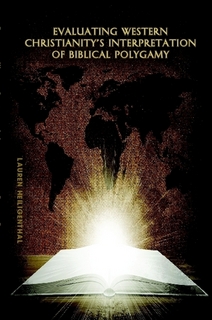
Some of you may have read my “About Me” section which mentions that I’ve had a book in the works. The day has finally come, and now it’s available for sale 🙂 The book is called Evaluating Western Christianity’s Interpretation of Biblical Polygamy. Yes, I imagine that most people will find this a controversial topic, and I plan on explaining the back story in an upcoming post. However, today I will simply include the summary of the book to whet your appetite:

“This book demonstrates that the popular Western worldview regarding marriage affects biblical interpretation. While most Western societies uphold monogamy as God’s ideal form of marriage, a number of other cultures practice polygamy. Western Christianity often perceives polygamy as a threat to the monogamist ideal; therefore, this book evaluates whether the Bible clearly advocates that polygamous men should become monogamous through divorce. The majority of the evaluative process focuses on five biblical texts that many scholars frequently use to oppose polygamy. Most of their arguments stem from Gen. 2:20-24 because God creates one woman for Adam, thereby instituting the monogamist ideal for all people. This interpretation is then transferred to other texts, including Gen. 30:1-24, Matt. 19:3-9, 1 Tim. 3:2, 12, and Titus 1:6. This book assesses the opposing arguments by exposing assumptions and potential biases, and also by reviewing the historical and social concepts of marriage in the Ancient Near Eastern and the Greco-Roman periods. After interpreting Scripture through the lens of the biblical audience, this book then applies the interpretations from the five biblical texts to a modern situation involving polygamy. Since there is no biblical text that explicitly prohibits polygamy or promotes monogamy, this book argues that the interpretation of the monogamist ideal tends to derive from one’s worldview rather than the Bible.”

The book is currently being sold at http://www.lulu.com/shop/lauren-heiligenthal/evaluating-western-christianitys-interpretation-of-biblical-polygamy/paperback/product-21877418.html.

I would also like to draw your attention to my publisher’s website http://www.patriarchpublishinghouse.com/ which should have the book listed at some point. You can also visit the publisher’s blog at http://patriarchsjournal.wordpress.com/ for more information on this topic.

© Lauren Heiligenthal

Critiquing “The Message” Bible

There’s no doubt that The Message Bible has been popular since the NT portion was released in 1993. The contemporary and poetic language has captured the attention of millions, but does it really convey the true Gospel message? While many have appreciated The Message, many others have denounced it as an accurate translation (or rather, a paraphrase of Scripture). Others even call it heretical. I have never really used this version for study or devotions, but I’ve seen it used by pastors and other Christians on Facebook, and I’ve even heard from some Seminary staff and students that they have used this version (at times) for sermons and lessons. It’s all about making Scripture easier to understand, or is it? I decided to do some research and find out what Eugene Peterson (the author of The Message) has to say about his version of Scripture.

Through my research I’ve discovered that Peterson has written many books and seems to be (or was at some point) a contributor to Christianity Today. He has also been the subject of a number of interviews concerning new books he’d written, including The Message, and his life as a pastor. The best way to find out Peterson’s views and intentions behind his writing is to hear/read it from the man himself. I’d like to share with you some of what he’s shared publicly. I will also include a list of the sources I read at the bottom of the post so you can verify what I’ve written here.

In one article entitled “The Joyful Environmentalists,” Eugene Peterson and Peter Harris were both interviewees who shared their convictions about conservationism. When Peterson was asked about Scriptures that teach about creation (besides Gen. 1-2 and Rom. 8:22), he responds with the plagues in Egypt:

“Those 10 plagues are all exorcisms of specific aspects of Pharaoh’s control over the world. For eight months, the whole country of Egypt was turned into a theater of exorcism, item by item by item. Pharaoh was unable to do what he had done to creation, and the evil was exorcised by the command of God…Then out of this highly technologized world of Egypt—the pyramids, the statuary, the temples—[the Hebrews] go into the wilderness, which is supposed to be empty. Yet they are all provided for, and they live by the providence of God in a most unlikely place. You can bet that they gained an appreciation for the fertility of the world they were living in—that they did not need all of Pharaoh’s technology to be provided for. That’s a great environmental text, even though I don’t think it’s ever been used that way.”[1]

I believe Peterson’s interpretation is a misrepresentation of the text for a couple of reasons. First, it wasn’t fertile in the wilderness. This is why God Himself had to provide for the Israelites in miraculous ways. They actually wanted to go back to Egypt, and their griping and complaining resulted in God’s wrath. Second, the plagues on Egypt had nothing to do with Pharaoh’s control in the world (in Egypt really), but rather because he would not adhere to God’s command. Peterson’s answer is a bit of a stretch (which he admits that he’s probably the only person to interpret the passage in this way), but this gives us a clue into how he interprets Scripture and how that interpretation gets inserted in his paraphrase of The Message.

While the previous article was written years after the completion of The Message, this next article was written by Peterson around the time when the NT portion of The Message was published (1993). In this article entitled “Spirit Quest,” Peterson asserts that the two essentials of human fullness are intimacy and transcendence.  He defines intimacy as “we want to experience human love and trust and joy” and transcendence as “we want to experience divine love and trust and joy.”[2] He explains that spirituality is a fusion of intimacy and transcendence, but North Americans usually don’t find these in the right places because we live in a secularized culture. As a result, Peterson writes, “Contemporary spirituality desperately needs focus, precision, and roots: focus on Christ, precision in the Scriptures, and roots in a healthy tradition. In these times of drift and dilettantism, evangelical Christians must once again serve the church by providing just such focus and precision and rootage.”[3] I pretty much agree with this statement; however, I’m confused that Peterson desires for the precision of Scriptures, but he himself writes an Americanized paraphrase of Scripture. He also provides “five items of counsel in matters of spirituality for all who hunger and thirst after intimacy and transcendence.”[4] I will only mention the first item since it applies to the discussion on The Message. This item of counsel is “Discover what Scripture says about spirituality and immerse yourself in it.” He provides an explanation of how to do this: “This is not a matter of hunting for a few texts, but of acquiring a biblical imagination—entering into the vast world of the Bible and getting a feel for the territory, and instinct for reality.”[5] The idea of acquiring a biblical imagination makes me pause. My hesitancy is also coupled with some of Peterson’s words in the introduction to the NT portion of The Message: “This version of the New Testament in a contemporary idiom keeps the language of the Message current and fresh and understandable in the same language in which we do our shopping, talk with our friends, worry about world affairs, and teach our children their table manners. The goal is not to render a word-for-word conversion of Greek into English, but rather to convert the tone, the rhythm, the events, the ideas, into the way we actually think and speak”(Bold print added for emphasis).[6]  So why the need for such contemporary language and biblical imagination? Peterson explains that too.

In 1991 (Pre-The Message), Peterson wrote an article called “Listen, Yahweh,” which explains his desire to pray the prayers of Psalms. However, from his perspective, the way most English translations relay the messages of the Psalms is not quite right. He explains,

“In English translation, the Psalms sound smooth and polished. Elizabethan rhythms and diction dominate. And as literature, they are beyond compare. But as prayer, as the utterances of men and women passionate for God in instants of anger and praise and lament, these English translations miss something. Grammatically they are accurate. The scholarship undergirding the translations is superb and devout. But as prayers they are not quite right: The Psalms in Hebrew are earthy and rough. They are not genteel. They are not prayers of nice people, couched in cultured language. And so in my pastoral work of teaching people to pray, I have for a long time wanted to translate the Psalms into what I think of as ‘American.’”[7]  (Bold print added for emphasis)

I don’t know about you, but when I read the Psalms (I choose to read the NASB, which I’ll explain later), I understand that the writers had reverence for God, and yet were also quite open with Him. Do their prayers not reflect our own when we feel like God is not around? Do we not express our disbelief as to what is allowed to happen in this world? Do we not hold onto hope that God is still sovereign and the Rock upon we which stand? I think it’s a common misconception that the Israelites (or even in the Greek-speaking world of the NT) were some sort of ancient hillbillies who couldn’t communicate with beautiful and elegant speech. How can various scholars’ translations with the Psalms be grammatically accurate, superb, and devout, yet still miss the “real” meaning and sound of the Psalms? To me, that accusation seems quite arrogant. To give you an understanding of where I’m coming from, let’s compare The Message version of Psalm 2 with the NASB version:

1-6 Why the big noise, nations?
Why the mean plots, peoples?
Earth-leaders push for position,
Demagogues and delegates meet for summit talks,
The God-deniers, the Messiah-defiers:
‘Let’s get free of God!
Cast loose from Messiah!’
Heaven-throned God breaks out laughing.
At first he’s amused at their presumption;
Then he gets good and angry.
Furiously, he shuts them up:
‘Don’t you know there’s a King in Zion? A coronation banquet
Is spread for him on the holy summit.’

7-9 Let me tell you what God said next.
He said, ‘You’re my son,
And today is your birthday.
What do you want? Name it:
Nations as a present? continents as a prize?
You can command them all to dance for you,
Or throw them out with tomorrow’s trash.’

10-12 So, rebel-kings, use your heads;
Upstart-judges, learn your lesson:
Worship God in adoring embrace,
Celebrate in trembling awe. Kiss Messiah!
Your very lives are in danger, you know;
His anger is about to explode,
But if you make a run for God—you won’t regret it!” (Psalm 2 MSG)

1 “Why are the nations in an uproar
And the peoples devising a vain thing?
The kings of the earth take their stand
And the rulers take counsel together
Against the LORD and against His Anointed, saying,
‘Let us tear their fetters apart
And cast away their cords from us!’

He who sits in the heavens laughs,
The Lord scoffs at them.
Then He will speak to them in His anger
And terrify them in His fury, saying,
‘But as for Me, I have installed My King
Upon Zion, My holy mountain.’

‘I will surely tell of the decree of the LORD:
He said to Me, ‘You are My Son,
Today I have begotten You.
Ask of Me, and I will surely give the nations as Your inheritance,
And the very ends of the earth as Your possession.
You shall break them with a rod of iron,
You shall shatter them like earthenware.’”

10 Now therefore, O kings, show discernment;
Take warning, O judges of the earth.
11 Worship the Lord with reverence
And rejoice with trembling.
12 Do homage to the Son, that He not become angry, and you perish in the way,
For His wrath may soon be kindled.
How blessed are all who take refuge in Him!” (Psalm 2 NASB)

From what I can tell, Psalm 2 is in reference to Christ and His authority on the earth. Acts 13:33 and Hebrews 1:5 both attest to this. Acts 13:32-33 says, “And we preach to you the good news of the promise made to the fathers, that God has fulfilled this promise to our children in that He raised up Jesus, as it is also written in the second Psalm, ‘You are My Son; today I have begotten You.’” Hebrews 1:1-5 speaks reverently about Christ: “God, after He spoke long ago to the fathers in the prophets in many portions and in many ways, in these last days has spoken to us in His Son, whom He appointed heir of all things, through whom also He made the world. And He is the radiance of His glory and the exact representation of His nature, and upholds all things by the word of His power. When He had made purification of sins, He sat down at the right hand of the Majesty on high, having become as much better than the angels, as He has inherited a more excellent name than they. For to which of the angels did He ever say, ‘You are My Son, Today I have begotten You’? And again, ‘I will be a Father to Him And He shall be a Son to Me’?” (Bold print added to emphasize the Psalm 2 reference). Scripture itself testifies to the meaning of Psalm 2, and I believe reverence is lacking in the MSG version. But you can make that decision for yourself. One reviewer (Raymond C. Ortlund, Jr.) of Peterson’s The Psalms at Prayer comments:

“Is bringing the language of Holy Scripture down to the level of common American discourse a worthy goal to begin with? Lovers of the Hebrew Psalter will agree with C.S. Lewis’s observation that the Psalms evoke both raw emotional intensity and high liturgical sublimity. They conjure up in our imaginations not only the cries of elemental human passion but also the voices of an Anglican boys’ choir…The Hebrew Psalter is intense but not pedestrian…Being earthy and rough may feel psychologically authentic to us modern people, but Bible translators should risk sounding remote when biblical beauty demands it. It then becomes the responsibility of pastors to lift modern people up to the level of Scripture, so that they can love higher and grander things than modernity has conditioned them to expect or even desire.”[8]

This same reviewer also asks a challenging question that relates to our current culture:

“At a time when American Christianity is rapidly adjusting to popular culture, when just about the only thing left that might rescue us from its banalities is the Bible, is it helpful to put a spin on the biblical text that accommodates popular culture even further? The problem with our more formal versions of the Psalms is not that they cannot help us to pray, but that they call us to a depth of prayer that our modern superficiality has habituated us not to identify with.”[9]

This statement was written 19 years ago, but I think it is even truer today. What is also interesting is that Peterson claims that trying to be relevant is really irrelevant. He supposedly doesn’t agree with relevancy. Let’s see what he said in his interview with Mark Galli (“Spirituality for All the Wrong Reasons”) about his book series on spiritual theology. In response to a question about the church, Peterson replies,

“What other church is there besides institutional? There’s nobody who doesn’t have problems with the church, because there’s sin in the church. But there’s no other place to be a Christian except the church. There’s sin in the local bank. There’s sin in the grocery stores. I really don’t understand the naïve criticism of the institution. I really don’t get it. Frederick von Hugel said that the institution of the church is like the bark on the tree. There’s no life in the bark. It’s dead wood. But it protects the life of the tree within. And the tree grows and grows and grows and grows. If you take the bark off, it’s prone to disease, dehydration, death. So, yes, the church is dead but it protects something alive. And when you try to have a church without bark, it doesn’t last long. It disappears, gets sick, and it’s prone to all kinds of disease, heresy, and narcissism. In my writing, I hope to recover a sense of the reality of congregation—what it is. It’s a gift of the Holy Spirit. Why are we idealizing what the Holy Spirit doesn’t idealize? There’s no idealization of the church in the Bible—none. We’ve got two thousand years of history now. Why are we so dumb?”[10] (Bold print added for emphasis)

All I can say is “Wow!” The church is dead? The church is not supposed to be an institution, but rather the body of Christ. While we are all sinners, sin is supposed to be confronted and rebuked in love within the church. The comparison to being the bark of a tree makes no sense. Is the body of Christ dead? Surely Christ was raised, so why is His body compared to death? If the church is the bark (dead) what are we keeping alive? What is the tree? The Scriptures? The same Scriptures that say we are alive in Christ and we should have the utmost joy for what He’s done for us? Peterson says that there’s no idealization of the church in the Bible, but Paul and other apostles and disciples provide a number of instructions so that the church can be holy and set apart. We live in a sinful world, but that doesn’t mean we let sin thrive within us individually and in the church.

Within this same interview, Galli asks Peterson, “Many Christians hope to speak to generation X or Y or postmoderns, or some sub-group, like cowboys or bikers—people for whom the typical church seems irrelevant.” Peterson responds, “When you start tailoring the gospel to the culture, whether it’s a youth culture, a generation culture or any other kind of culture, you have taken the guts out of the gospel. The gospel of Jesus Christ is not the kingdom of this world. It’s a different kingdom.”[11]

I agree with Peterson’s response. The gospel shouldn’t be tailored to culture. So how does The Message, which strives to accomplish the very task that Peterson is against, fit with his philosophy?

Another interview demonstrates that his views about relevancy seem to be contradictory. In this interview, “Letter from a Roman Jail,” in which Peterson’s paraphrase of Philippians is copied, Peterson answers some questions about his paraphrase. When asked “Whom is The Message for?” he replies,

“People like Tom, the trucker and furniture mover who transported our belongings across the country. He left parochial school in the eighth grade and hasn’t been back to church since. But his ears pricked up when he heard about this. I wrote for people like him who don’t think they can understand the Bible or ‘churchy’ language. I also hope it helps Christians who are tired of the world, of the biblical phrases. They’re not bored when they talk to their friends and gossip over the back fence. I tried to use the same vernacular. I hope they’ll pick this up and be surprised.”[12]

So instead of helping people understand Scripture in its original context, Peterson chooses to make it relevant to people in the current culture partly because they’re bored of the usual. Does this not seem inconsistent with previous interview? As another clear demonstration of being relevant, Peterson is asked, “The Word ‘dwelt among us’ in John 1 became ‘moved into the neighborhood.’ Why did you overhaul such metaphors?” His response was that “‘Dwelt among us’ was likely something people said in the first century. But I’ve never heard anybody say that except when they’re quoting the Bible. ‘Moved into the neighborhood’ is something we would say. I wanted to use a phrase that came out of people’s experience. Jesus was a master at doing this. His listeners didn’t have to read a commentary to figure out what he was saying.”[13]

Actually, even Jesus’ disciples were often confused with the meaning of Jesus’ parables. They usually needed to be explained even to His closest followers. Yes, Jesus used metaphors that related to the people of the day, but it was all to convey spiritual truth. It is our job to understand those metaphors, not make up our own (for translation). The concept of Jesus, the Son of God Himself, coming to earth to dwell among us is quite an amazing thought. He chose to leave His throne to be with His creation, a creation He knew He would die for. The idea of “moving into the neighborhood” does not convey that same idea. At least, not to me. Peterson also admits that he made ambiguous language in Scripture less ambiguous. His reason is that the original message wouldn’t have been ambiguous and wasn’t with Paul and Jesus; therefore, Peterson “felt liberty to be as clear as I could within the bounds of evangelical theology.”[14] That means that Peterson’s paraphrase is written through a particular lens, that of evangelical theology. While other scholars and translators feel the need to leave ambiguous passages as they are, Peterson seems to believe he has more insight into their meaning.

The interviewer also asks Peterson “How did your interest in poetry help your translating?” Peterson responds,

“When you love words, you want them to sound fresh. When a word becomes a cliché, it’s not working anymore; so you tend not to use it. Philosopher Martin Heidegger said that poets are the shepherds of words. As a shepherd, you’re not just trying to get the sheep to the market and get the best price for them. You’re taking care of them along the way. I’m trying to reach disaffected outsiders and bored insiders. I hope The Message becomes a means by which a lot of people who’ve never read the Bible read it. And the means by which many who’ve stopped reading will start again.”[15]

Again, it seems that the focus of The Message is to cure boredom or one’s disconnect with Scripture through an overhaul of fresh words. Yes, such an approach has led many to read The Message like any other book, but have they gained spiritual understanding? Or have they found just another “cool” way to say something that was supposedly outdated?

I have one more article to discuss, and I think this one needs the most attention. This is another interview with Peterson, but it focuses entirely on his work with The Message. It initially explains that Peterson wrote a paraphrase of Galatians for his congregation because they didn’t seem to be connecting with Scripture. NavPress saw this paraphrase and approached Peterson about writing the entire NT this way. The interviewer (Doug LeBlanc) asks, “Was there a breakthrough moment when you became convinced that you should expand your work from Galatians to the rest of the New Testament?” Peterson replies,

“I was a reluctant participant in this. I really didn’t think that I could do it or that it could be done. But I agreed with my editor, John, that I would. In some ways Paul is easy. There’s a lot of challenge to Paul, but the gospels are something quite different. There’s a kind of clean, lucid clarity to them, and I just didn’t think I could do that. But I agreed to do 10 chapters of Matthew and then let John decide whether he thought we could do this. And so it was just as bad as I thought it would be. It was very wooden, and it just wasn’t working. I just kind of let go and became playful. And that was when the Sermon on the Mount started. I remember I was down in my basement study, and I did the Beatitudes in about 10 minutes. And all of a sudden I realized this could work.[16] (Bold print added for emphasis)

I don’t quite think “playful” is the right kind of attitude to have when translating or paraphrasing Scripture. The next question is quite thought-provoking for anyone who reads or teaches from The Message. LeBlanc asks, “Do you sometimes use The Message for your own devotional reading?” Peterson surprisingly responds, “My wife does, but I don’t. Actually, I don’t want this to sound wrong, but for most of my adult life I have read the Bible in Greek and Hebrew. I still do that. When I finished the New Testament, I really couldn’t read The Message. It was like I lived in that world, and I didn’t know if it was going to be accepted. I just put it away. But occasionally now I’ll pick it up and remember what I was doing.”[17] I am wary to read or use a Bible translation/paraphrase that even the author himself doesn’t use. In Peterson’s interview with Timothy Jones (“Letter from a Roman Jail”), he says that “While we are calling what I’ve done a paraphrase, I’ve also often had the feeling that it is a true translation. I sometimes made wild jumps in terms of word order or metaphor, but I was still trying to work out of the original setting and speech.”[18] If that is the case, why does he have trouble reading his own translation? Something to think about.

Continuing on with his interview with LeBlanc, Peterson is asked what the challenges are when translating Scripture into street language. Here’s another important response:

“It’s very different than trying to give a literal translation. With a conventional translation you’re trying to be as close to the original culture and grammar and Greek syntax and Hebrew syntax as you can be, and invite the reader to enter that world and understand it in those terms. When you’re doing a paraphrase translation like I’ve done, the demand is not on your demonstrating that world, although you kind of do that, but there’s more of an imagination and poetic aspect to it, because you’re trying to recreate those rhythms or those images and metaphors in this culture. I don’t think I could have done this if I wasn’t a pastor.”[19] (Bold print added for emphasis)

Again, there’s mention of imagination and poetry as well as the lack of intention to help people understand the Bible in its original context. Even though he supposedly tries to recreate those rhythms, images, and metaphors in our current culture, I think the original intent is often lost in translation.

When asked what advice Peterson would give to anyone who attempts a paraphrase, Peterson says, “I think if there’s any counsel for this kind of translation work, you just have to be immersed in the everyday. You don’t go off to an ivory tower someplace and surround yourself with dictionaries and grammars. Although you’ve got to know those things, those are a presupposition; that’s not the world you immerse yourself in.”[20] So even though it’s necessary to have knowledge of Greek and Hebrew and the ancient cultures, it’s more important to be immersed in the everyday. It’s becoming clear that this paraphrase (even though previously Peterson called his work a true translation) was not intended to communicate the original context. While I believe Scripture can and should be applied to our modern context, I don’t think it should be translated as if the events took place in our modern context.

But wait, there’s more! LeBlanc asks Peterson, “Do you think The Message will be well suited for reading in worship?” We would think Peterson would be on board with pastors and leaders using his translation at the pulpit. After all, isn’t it written for those who have become disconnected with Scripture? But Peterson replies with the opposite response, “When I’m in a congregation where somebody uses it in the Scripture reading, it makes me a little uneasy. I would never recommend it be used as saying, ‘Hear the Word of God from The Message.’ But it surprises me how many do. You can’t tell people they can’t do it. But I guess I’m a traditionalist, and I like to hear those more formal languages in the pulpit.”[21] Why would he want to hear the more formal languages when his translation communicates the meaning behind the Scriptural text? The next response is just as contradictory as this one.

The interviewer asks, “You have said that if you dig your wells deep enough, relevancy is pretty much irrelevant. What sorts of hazards await a translator who focuses on relevance?” Here’s that relevance topic again. Let’s take a look at what Peterson says:

“The hazard is just triviality. Relevance is relevant for about 10 minutes in the kind of culture we’re in. I never thought of relevance. I was thinking of my congregation. I was thinking of these people, the lives they lived. I didn’t want to be cute; I didn’t want to just get people’s attention. So I was always working very closely with those Greek and Hebrew texts, trying to get underneath them and get into them, and then let it come out as the kind of language that we’re using. And I wasn’t trying to make it easy. I was astounded when I learned about some of the new versions of the Bible that are being published by companies that spend thousands of dollars trying to find the vocabulary level of the average person and exclude all the words that don’t fit into that grid. I think you do the best you can with the language you have. The fact is, the Bible is hard. It’s not an easy book. I don’t think we should compromise accuracy of the Bible just for the ease of reading.[22] (Bold print added for emphasis)

Ok let’s break this down. Peterson says he wasn’t trying to be relevant, but he was thinking about the people and the lives they lived. He already admits in other interviews that his congregation seemed to be bored or disengaged from Scripture so he wrote a paraphrase of Galatians to make Scripture more real and understandable to them. To apply to them. That is being relevant. Also, he mentions how he was always working very closely to the Greek and Hebrew texts, yet he encourages people who want to write a paraphrase to not surround themselves with grammars and dictionaries, but to be immersed in the everyday. The idea of trying to get underneath these ancient texts seems to indicate that the intended meaning was not on the surface, that it needs to be drawn out. This is where interpretation can become dangerous. Peterson is trying to get the feel behind the text (something that is supposedly hidden) and somehow translate into our modern language with all of its (unrelated) idioms. Peterson then mentions how the Bible is hard, and it shouldn’t be made easy to read just for the sake of ease. Why is the Bible so hard?? I think he and others think this because they’ve lost the focus on the original context. They have their own preconceived notions about who God is and if the God of the original context does not fit their notions then something is amiss. Rather than blaming themselves for their own misunderstanding, they blame the text. In the ancient Israelite culture and in the first century, God is a no-nonsense God. Christ was and remains to be the greatest gift we could ever receive because He took the Father’s wrath upon Himself. But that doesn’t change the nature of God. Our culture wants a fluffy, warm God who just loves, loves, loves in a way that we think of love. Scripture presents a different picture. God hates sin. Period. Every human needs to be made right with God because we all sin. The story of God’s redemption of mankind is no longer a mystery. The Messiah came as the OT Scriptures prophesied, and Christ will come again as the NT testifies. If the Bible is hard, we made it that way. I think Peterson completely contradicts himself when he says “I don’t think we should compromise accuracy of the Bible just for the ease of reading.” Isn’t that exactly what he did with The Message? He himself says it was written for people like Tom the trucker because he dropped out of school in the eighth grade. If you take a brief look at comments on Amazon you’ll see that many people like The Message in all its forms because it reads with ease.

There’s one final question and response that I’d like to add this discussion. LeBlanc asks, “Do you consider it one of the unique qualities of Scripture that it can be translated into so many forms and still retain such spiritual power?” Peterson responds,

“An African theologian, [Kwame] Bediako [author of Christianity in Africa: The Renewal of Non-Western Religion], says that every time the Bible is translated it releases new meanings. And he was talking about African languages and African dialects. Every time the Bible is translated, you enter a culture and a language system that is unique. And the Bible is true and gets into those rhythms and those idioms and there’s more truth there. So the truth is kind of endless, and each culture, dialect, and language gives a new chance to express something nobody has ever quite done this way before. The comments of appreciation that mean the most to me are from Wycliffe translators. They’re doing this, and they understand immediately what I’m doing, and they love it.”[23]

I’m all for translating the Bible into different languages, and I love languages myself. However, I have a problem with the idea that Bible translation leads to additional new meanings of Scripture. This leaves room for any interpretation to be inserted into the text. I believe the Bible is for all people in all cultures, but we cannot neglect the original cultures involved. How can we fully understand the necessity of Christ’s death if we have no knowledge of the Israelites’ command to offer sacrifices for their sins? There’s a reason why God chose Israel initially, but then He extended salvation for all people. Scriptural truths are immutable; however, application of Scriptural truths is endless. There is a difference. If truths multiply and change with every culture, how can we be rooted in these same Scriptures? The Bible was originally written in Hebrew, Aramaic, and Greek, and we are able to grasp the truths in English. Why do we think that other cultures and languages can’t understand these same principles without compromising the original context? The same Scriptural truths should be gleaned from the text, and then these truths can be applied differently to various cultures, including our own. All that to say, if someone proclaims that they’ve discovered a new meaning in Scripture which has never been found before, be wary of such a person. It is quite arrogant to assume that over thousands of years no one else understood such a truth.

Choosing a Translation

I’m not writing all of this to shame anyone who reads The Message. Rather, I think this version has been encouraged by many Christians (even well-known leaders and writers), but I don’t think it should be. I’m writing this post to not only make you aware of Peterson’s intentions, inconsistencies, and beliefs, but also to challenge everyone to research a Bible translation before they use it for personal study or teaching. If you are seeking to understand Scriptural truth, I highly recommend not choosing a paraphrase because the goal of a paraphrase is not to explain the original context. I will also say that no translation is perfect. As much as we want to have an exact translation, the number of Bible versions out there indicate that an exact translation is impossible. Why is this? Well, whenever we translate from one language to another (especially ancient languages), an amount of interpretation is involved. Sometimes cultural concepts or idioms are incomprehensible unless we do adequate research. Even then, some phrases may get lost in translation. Also, whenever interpretation is involved, subjectivity goes along with it. As much as we try to remain objective when reading (or translating) Scripture, we’re still impacted by our own cultures, languages, morals, church traditions, theological positions, etc. This is why having a group of editors and translators is important for writing a new Bible translation. A group of people can keep each other in check whereas one person has little to no accountability. A group can debate on more “difficult” passages whereas one person can only offer his/her opinion and interpretation on a given passage. While Peterson admits to having five scholars check his work for doctrinal integrity[24], I think it’s safe to say that he was mostly left to his own creativity.

I mentioned above that I personally choose to read the New American Standard Bible (not to say that others aren’t adequate). I read this version because it’s the closest translation I’ve found to the original languages (although I admit that I’ve only studied Greek, and plan to study Hebrew someday). Also, it was written by a group of editors and translators beginning in 1960 and has been through many revisions, the latest revision published in 1995. The Foreword to the NASB conveys, “The purpose of the Editorial Board in making this translation was to adhere as closely as possible to the original languages of the Holy Scriptures, and to make the translation in a fluent and readable style according to current English usage.”[25] The Lockman Foundation, the original publisher for this version, also provides its fourfold aim with its translation: 1) These publications shall be true to the original Hebrew, Aramaic, and Greek; 2) They shall be grammatically correct; 3) They shall be understandable; and 4) They shall give the Lord Jesus Christ His proper place, the place the Word gives Him; therefore, no work will ever be personalized.[26] This version provides introductory notes that explain what the NASB is based on (both the ASV and KJV), who was involved in the process, why they used some English idioms for clarity in certain passages, and how they indicate these changes within the textual notes. I currently use the Study Bible version of the NASB which is published by Zondervan, but I’m not inclined to use the commentaries very much. Actually, I encourage everyone to be careful when reading commentaries (whether those in your Bibles or those independent of a specific translation). Commentaries can be useful, and they’re often encouraged in higher education; however, it is important to remember that they are written by men and women who all have their own biases and interpretations. Scripture itself provides the context you need to understand it. Commentaries can help fill in the gaps where culture and history are concerned.

Challenge: Compare Translations

There might be some people reading this who are saying, “Hey, I love The Message!” However, I challenge everyone who has an interest in this version (or even if you don’t) to do a translation comparison (www.biblegateway.com is helpful with this) and determine if the message is really the same. I’ve included a few comparisons below, beginning with the Lord’s Prayer. I’ll give you the NASB version and then The Message (MSG):

“Our Father who is in heaven,
Hallowed be Your name.
Your kingdom come.
Your will be done,
On earth as it is in heaven.
Give us this day our daily bread.
And forgive us our debts, as we also have forgiven our debtors.
And do not lead us into temptation, but deliver us from evil.

[For Yours is the kingdom and the power and the glory forever. Amen.]” (Matthew 6:9-13 NASB)

“Our Father in heaven,
Reveal who you are.
Set the world right;
Do what’s best—
as above, so below.
Keep us alive with three square meals.
Keep us forgiven with you and forgiving others.
Keep us safe from ourselves and the Devil.
You’re in charge!
You can do anything you want!
You’re ablaze in beauty!
Yes. Yes. Yes.” (Matthew 6:9-13 MSG)

I believe much is missed with the second version, and it seems quite Westernized with the idea of “three square meals.” What do you think? Now let’s take a look at Galatians 6:1-2:

“Brethren, even if anyone is caught in any trespass, you who are spiritual, restore such a one in a spirit of gentleness; each one looking to yourself, so that you too will not be tempted. Bear one another’s burdens, and thereby fulfill the law of Christ.” (Galatians 6:1-2 NASB)

“Live creatively, friends. If someone falls into sin, forgivingly restore him, saving your critical comments for yourself. You might be needing forgiveness before the day’s out. Stoop down and reach out to those who are oppressed. Share their burdens, and so complete Christ’s law.” (Galatians 6:1-2 MSG)

I think there are two different messages going on here. In the NASB translation, I believe Paul is telling people to restore a person who has fallen into a sin that he/she can’t seem to get out of. That means that their sin is known, but believers are to help them with a gentle spirit. However, those who are helping this person need to be cautious so that they don’t get caught up in the same sin. When Paul is telling the Galatians to bear each other’s burdens, he’s speaking to the church. In the MSG translation, I have no idea where “Live creatively, friends” comes from (not from the Greek). It also seems to suggest that people should just forgive the person in sin, but nothing else should be said. This is not the message in the NT. The church is called to rebuke as well as encourage and forgive. I’m not suggesting that we should rub people’s sin in their faces, but rebuking in love is necessary. The MSG also adds that we should share the burdens of the oppressed and fulfill Christ’s law. This is not the message Paul is saying. He’s talking to the Galatian church specifically here. The church is supposed to carry one another’s burdens because we are all one body (1 Cor. 12). We are not commanded to share everyone’s burdens. Again, I believe the real message is lost in the paraphrase (MSG).

Here’s another example. This one is really important especially because of the rise of homosexuality and homosexual marriage in Western culture. Let’s compare 1 Corinthians 6:9-11. See if you can note the differences:

“Or do you not know that the unrighteous will not inherit the kingdom of God? Do not be deceived; neither fornicators, nor idolaters, nor adulterers, nor effeminate, nor homosexuals, nor thieves, nor the covetous, nor drunkards, nor revilers, nor swindlers, will inherit the kingdom of God. Such were some of you; but you were washed, but you were sanctified, but you were justified in the name of the Lord Jesus Christ and in the Spirit of our God.” (1 Cor. 6:9-11 NASB)

“Don’t you realize that this is not the way to live? Unjust people who don’t care about God will not be joining in his kingdom. Those who use and abuse each other, use and abuse sex, use and abuse the earth and everything in it, don’t qualify as citizens in God’s kingdom. A number of you know from experience what I’m talking about, for not so long ago you were on that list. Since then, you’ve been cleaned up and given a fresh start by Jesus, our Master, our Messiah, and by our God present in us, the Spirit.” (1 Cor. 6:9-11 MSG)

There are so many differences I’m not even sure where to start. While the NASB (and Greek) translation lists specific sins (not that these are the only sins that keep people from God, but I think they are listed specifically for the Corinthians and the cultural influences of their day), the MSG conveniently leaves them out. It also adds the idea of using and abusing the earth. This is something not mentioned in the Greek language but represents a modern concern. In my opinion, the MSG version does not want to cause offense by calling out certain sins, but rather desires to present God as warm and fuzzy. Here’s a final comparison that represents this version of God:

“For whatever was written in earlier times was written for our instruction, so that through perseverance and the encouragement of the Scriptures we might have hope. Now may the God who gives perseverance and encouragement grant you to be of the same mind with one another according to Christ Jesus…” (Romans 15:4-5 NASB)

“Even if it was written in Scripture long ago, you can be sure it’s written for us. God wants the combination of his steady, constant calling and warm, personal counsel in Scripture to come to characterize us, keeping us alert for whatever he will do next. May our dependably steady and warmly personal God develop maturity in you so that you get along with each other as well as Jesus gets along with us all.” (Romans 15:4-5 MSG)

I’ll let you wrestle with the differences there.

For anyone who has taken the time to read this post to the end, I thank you from the bottom of my heart. My desire is for truth to be known and understood. Part of this call for truth is calling out people who I think lead people away from it. Even with the best of intentions, if someone (like Peterson) does not teach the truth of Scripture, he is not doing God’s work.

Bibliography (sources used in this post or consulted)

Burns, Ann and Barbara J. Kenney. “The Message: The New Testament (Book).” Library Journal 128 no. 18 (Nov. 2003): 140.

Crouch, Andy (Interviewer), Eugene Peterson (Interviewee) and Peter Harris (Interviewee). “The Joyful Environmentalists.” Christianity Today 55 no. 6 (June 2011): 30-32.

Galli, Mark (Interviewer) and Eugene Peterson (Interviewee). “Spirituality for All Wrong Reasons: Eugene Peterson talks about lies and illusions that destroy the church.” Christianity Today 49 no. 3 (March 2005): 42-48.

LeBlanc, Doug (Interviewer) and Eugene H. Peterson (Interviewee). “I Didn’t Want to Be Cute.” Christianity Today 46 no. 11 (Oct. 2002): 107-109.

Ortlund Jr., Raymond C. “The Psalms at Prayer.” Christianity Today 39 no. 1 (Jan. 1995): 64-65.

Peterson, Eugene H. “Letter from a Roman Jail: Words of liberation from a prisoner of conscience. A new paraphrase of Philippians by Eugene Peterson.” Christianity Today 37 no. 15 (Dec. 1993): 38-42.

—–. “‘Listen, Yahweh.’” Christianity Today 35 no. 1 (Jan. 1991): 23-25.

—–. “Spirit Quest.” Christianity Today 37 no. 13 (Nov. 1993): 26-30.

Wood, David (Interviewer) and Eugene H. Peterson (Interviewee). “‘The Best Life’: Eugene Peterson on pastoral ministry.” Christian Century 119 no. 6 (Mar. 2002): 18-26.

Additional Internet Sources:

http://www.gotquestions.org/The-Message-MSG.html

http://www.bible-researcher.com/themessage.html

http://www.crossroad.to/Bible_studies/Message.html

[1] Andy Crouch (Interviewer), Eugene Peterson (Interviewee) and Peter Harris (Interviewee), “The Joyful Environmentalists,” Christianity Today 55 no. 6 (June 2011): 31.

[2] Eugene H. Peterson, “Spirit Quest,” Christianity Today 37 no. 13 (Nov. 1993): 28.

[3] Peterson, “Spirit Quest,” 29.

[4] Peterson, “Spirit Quest,” 29.

[5] Peterson, “Spirit Quest,” 29.

[6] Eugene H. Peterson, The Message: The New Testament in Contemporary Language (Colorado Spring, CO: NavPress, 1993), 8.

[7] Eugene H. Peterson, “‘Listen, Yahweh,’” Christianity Today 35 no.1 (Jan. 1991): 23.

[8] Raymond C. Ortlund, Jr., “The Psalms at Prayer,” Christianity Today 39 no.1 (Jan. 1995): 65.

[9] Ortlund, “The Psalms at Prayer,” 65.

[10] Mark Galli (Interviewer) and Eugene Peterson (Interviewee), “Spirituality for All the Wrong Reasons: Eugene Peterson talks about lies and illusions that destroy the church,” Christianity Today 49 no. 3 (March 2005): 45-46.

[11] Galli and Peterson, “Spirituality for All the Wrong Reasons,” 47.

[12] Timothy Jones (Interviewer) and Eugene H. Peterson (Interviewee), “Letter from a Roman Jail: Words of liberation from a prisoner of conscience. A new paraphrase of Philippians by Eugene Peterson,” Christianity Today 37 no. 15 (Dec. 1993): 41.

[13] Jones and Peterson, “Letter from a Roman Jail,” 41.

[14] Jones and Peterson, “Letter from a Roman Jail,” 41.

[15] Jones and Peterson, “Letter from a Roman Jail,” 41.

[16] Doug LeBlanc (Interviewer) and Eugene H. Peterson (Interviewee), “I Didn’t Want to Be Cute,” Christianity Today 46 no. 11 (Oct. 2002): 107.

[17] LeBlanc and Peterson, “I Didn’t Want to Be Cute,” 107.

[18] Jones and Peterson, “Letter from a Roman Jail,” 41.

[19] LeBlanc and Peterson, “I Didn’t Want to Be Cute,” 107-108.

[20] LeBlanc and Peterson, “I Didn’t Want to Be Cute,” 108.

[21] LeBlanc and Peterson, “I Didn’t Want to Be Cute,” 108.

[22] LeBlanc and Peterson, “I Didn’t Want to Be Cute,” 108-109.

[23] LeBlanc and Peterson, “I Didn’t Want to Be Cute,” 109.

[24] Jones and Peterson, “Letter from a Roman Jail,” 41.

[25] New American Standard Bible (LaHabra, CA: The Lockman Foundation, 1995), vii.

[26] New American Standard Bible, vii.

© Lauren Heiligenthal
Reflections on a Porch

I’m in the process of writing a longer post, but in the meantime I’d like to share another poem I wrote a few years ago (although it’s been tweaked a little since then). I was sitting on my parents’ front porch during a storm with my feet exposed to the rain. While observing the storm, the elements reminded me of the importance of unity within the church. With pen and paper in hand, I composed these thoughts:

Storm

I delight in the sound of rain

and its staccato touch on my feet as the drops fall

independently.


They fall independently,

yet as a whole they create a shower of blessing and peace;

but only as one.


We can also touch other lives as individuals and make a significant difference,

but only when we work as one can there be an outpouring of blessing,

of victory.


The stillness is calming,

the occasional clap of thunder inviting

as it reminds us warriors of the ongoing battles we fight.


Lightning is the most miraculous of all

for even when all is dark and stormy,

light pierces the darkness.


Lightning takes the darkness by surprise,

and all is exposed.

Thunder follows,

alerting the warriors that the battle against evil

is one step closer to victory.


Exposing evil brings freedom.

© Lauren Heiligenthal

Speaking in Tongues: What the Bible Actually Teaches

I believe that spiritual gifts are as useful for this present age as they were for the first century church. The church is still in need of edification, and the world needs to know the Savior. Spiritual gifts are a way in which these two needs can be fulfilled. However, I advocate the proper use of spiritual gifts, a number of which have become distorted through misguided interpretation.  One of these misused gifts is speaking in tongues. Before I delve into Scripture for an explanation, I would like to briefly explain why this topic is important to me.

When I was ten years old, I was convinced that I had received the gift of speaking in tongues. Prior to receiving it, I had learned about it in church (I grew up Pentecostal). Even in a Missionettes class (a Bible study for girls) I was taught to start saying syllables and hopefully the heavenly language would just flow out. Over the years I observed others with the “gift” and was taught that speaking in tongues was a heavenly language that was between God and me. Even though I couldn’t understand what I was saying, it was supposedly a powerful prayer tool, and I even heard from the pulpit that the enemy can’t understand what I’m saying to God when I speak in tongues. I was taught that it couldn’t be controlled, like the Spirit just takes over. I believed most of these things for quite a few years. I’ve even been in services when people were encouraged to raise their voices in their heavenly languages, and a chorus of “unknown languages” rang out. But then I noticed my “language” started to change. It began to sound like languages I’ve learned or heard before. Questions began forming in my mind about the validity of this gift, but I pushed them aside for a few more years. It wasn’t until I was confronted about it with Scripture that I realized what I had learned in church and what Scripture teaches about speaking in tongues (which I will address below) were at odds with one another. I no longer “speak in tongues,” but my prayer life has been the better for it. However, I do believe that there is a spiritual gift of speaking in tongues, but it’s different from the Pentecostal view.

First, I would like to discuss the end of Luke 24 and Acts 1-2. In Luke 24 Jesus is about to ascend to heaven, but before this event, He tells His disciples something important in vv. 46-49: “Thus it is written, that the Christ would suffer and rise again from the dead the third day, and that repentance for forgiveness of sins would be proclaimed in His name to all the nations, beginning from Jerusalem. You are witnesses of these things. And behold, I am sending forth the promise of My Father upon you; but you are to stay in the city until you are clothed with power from on high.” In Acts 1 Luke reiterates these events. It is important to note in Acts 1:2-8 that Jesus is speaking specifically to the Apostles about the Holy Spirit coming upon them.  He makes it clear that they (the Apostles) will receive power from the Holy Spirit, they will be His witnesses, and they will proclaim the Gospel in all of the earth, beginning in Jerusalem. Again, vv. 12-13 also mention that it is the eleven Apostles who are given these instructions. Luke’s account continues with how the Apostles and others gather together to devote themselves to prayer. On one occasion, when there are about 120 people gathered (v. 15), Peter speaks up and says that another man should take Judas’ place among the Apostles. This event ends with Matthias being chosen. When Acts 2 begins, Luke is writing about the day of Pentecost, a different day than when the 120 were gathered together. I think many people assume that all of these people were filled with the Holy Spirit on Pentecost; however, Scripture does not indicate this. Let’s take a look at what happened.

Acts 2:1 opens with “When the day of Pentecost had come.” This indicates that this day is different from the previous event. It continues by saying that “they were all together in one place.” The closest reference to “they” is the Apostles, but I also think that Acts 2:14 affirms this claim. We’ll get to that in a moment. In vv. 2-3, we read about a noise from heaven “like a violent rushing wind” that fills the house and about tongues like fire which were being distributed and resting on each person present. Then v. 4 says, “And they were all filled with the Holy Spirit and began to speak with other tongues, as the Spirit was giving them utterance.”  If we stop here, the Pentecostal view of an unknown, heavenly language still seems to fit, but the actual meaning of “tongues” is further explained in the following verses. Verse 5 is a parenthetical note, but it’s important for this passage. It states that there were Jews living in Jerusalem from “every nation under heaven.” This indicates that they didn’t all speak the same language, which v. 6 affirms: “And when this sound occurred, the crowd came together, and were bewildered because each one of them was hearing them speak in his own language.” In v. 7 these same men are astonished because they know that the men speaking in tongues are from Galilee, meaning that they shouldn’t be able to speak all of the languages being spoken. Scripture provides even more clarification about this manifestation of the Spirit. The Jews say again in v. 8, “And how is it that we each hear them in our language to which we were born?” These men have been living in Jerusalem, yet they hear their native tongue, obviously a known language. Verses 9-11 make this point even more clearly by listing all the nations and regions where these Jews are from. If you look at a map that many Bibles provide, you’ll notice that there’s no way that these Galileans would have known all of these languages. Verse 11 also adds the Jews’ remark, “we hear them in our own tongues speaking of the mighty deeds of God.” Two major points to grasp so far is that this first example of speaking in tongues involves speaking known languages, and it is meant to testify about God’s greatness. Let’s continue.

While some people remain perplexed (v. 12), others mock the Apostles by basically saying they are drunk (v. 13). Verse 14 is the beginning of Peter’s defense: “But Peter, taking his stand with the eleven, raised his voice and declared to them: ‘Men of Judea and all you who live in Jerusalem, let this be known to you and give heed to my words.’” In my opinion, this verse affirms that this specific filling of the Holy Spirit was given to the Apostles because of what Jesus said in Luke 24:47 and Acts 1:8. The Gospel will be preached in Jerusalem first. Also, Peter is still addressing the same men, which means that he is still speaking in tongues here because the Jews understand him. As you can read for yourself, Peter not only defends their speaking in tongues through Joel’s prophecy (vv. 17-21), but more importantly, he shares the Gospel (vv. 22-36). When the Jews hear what Peter has to say “they were pierced to the heart, and said to Peter and the rest of the Apostles, ‘Brethren, what shall we do?’” (v. 37). They are told to repent and be baptized (v. 38). After these things they will receive the Holy Spirit (v. 38). Verse 41 testifies that about 3,000 people received Peter’s message and were baptized that day. The Holy Spirit enabled the Apostles to preach the Gospel in many languages at once and many were saved.

This moment in Acts marked the beginning of the church. Consider the magnitude of this situation. Literally thousands of people are hearing about Christ in their own language, and they become saved. These people could then share this good news with people in their native tongue. How quickly the Gospel would have spread! Jesus gave specific instructions to His Apostles to wait in Jerusalem so that the Holy Spirit would empower them to preach the Gospel to these people. Some Christians argue that the sign of being baptized in the Holy Spirit is speaking in tongues, and they use Acts 1 and 2 as proof texts. However, as I’ve repeated, the fact that Jesus told His Apostles that they (specifically) would be baptized with the Holy Spirit is important. Also, when they were baptized in the Holy Spirit and spoke other languages, it wasn’t something between just them and God. Additionally, they understood what they were saying because they were speaking in their own native tongue while others heard them differently. Ultimately, speaking in tongues was God’s way of using the Apostles to preach the Gospel to unbelievers. I’m not saying that the Apostles were the only people to receive this gift. Acts 10:46; 19:6 and 1 Corinthians 12-14 say otherwise, but I believe the reason why the Spirit empowered the Apostles in such a magnificent way was to usher in the beginning of the church. Their example in Acts is important to keep in mind when reading 1 Corinthians 12 and 14 because Scripture does not contradict itself. Also, the Apostles were the leaders of the church who were empowered by God, and this manifestation of the Holy Spirit demonstrated their authority. With Acts 1 and 2 fresh in our minds, let’s take a brief look at 1 Cor. 12 and discuss 1 Cor. 14.

Paul writes in 1 Cor. 12:4-7, “Now there are varieties of gifts, but the same Spirit. And there are varieties of ministries, and the same Lord. There are varieties of effects, but the same God who works all things in all persons. But to each one is given the manifestation of the Spirit for the common good.” He continues by listing all the different gifts and says in v. 11, “But one and the same Spirit works all these things, distributing to each one individually just as He wills.” Speaking in tongues and interpretation of tongues are listed among the gifts, but there is no indication that these particular gifts are what define someone as being baptized in the Holy Spirit. On the contrary, not everyone receives the same gifts. This is one reason why the body of Christ needs to be unified, both the honorable and less honorable parts (vv. 12-26). Also notice in v. 28 that the gift of “various kinds of tongues” is listed last. Then, in 1 Cor. 13 Paul explains how love is the greatest of all gifts. Without it, other gifts are useless, including prophecy and speaking in tongues. I believe he specifically mentions these two gifts in order to discuss them further in 1 Cor. 14. (Keep in mind that chapter breaks are man-made so all of these chapters are meant to be read together.)

In 1 Cor. 14, Paul seems to be addressing speaking in tongues because it had become important to the Corinthians; however, he encourages them to desire the gift of prophecy because it edifies the whole church body. Let’s take a look at what he tells the church in vv. 1-19:

Pursue love, yet desire earnestly spiritual gifts, but especially that you may prophesy. For one who speaks in a tongue does not speak to men but to God; for no one understands, but in his spirit (or by the Spirit) he speaks mysteries. But one who prophesies speaks to men for edification and exhortation and consolation. One who speaks in a tongue edifies himself; but one who prophesies edifies the church. Now I wish that you all spoke in tongues, but even more that you would prophesy; and greater is one who prophesies than one who speaks in tongues, unless he interprets, so that the church may receive edifying. But now, brethren, if I come to you speaking in tongues, what will I profit you unless I speak to you either by way of revelation or of knowledge or of prophecy or of teaching? Yet even lifeless things, either flute or harp, in producing a sound, if they do not produce a distinction in the tones, how will it be known what is played on the flute or on the harp? For if the bugle produces an indistinct sound, who will prepare himself for battle? So also you, unless you utter by the tongue speech that is clear, how will it be known what is spoken? For you will be speaking into the air. There are, perhaps, a great many kinds of languages in the world, and no kind is without meaning. If then I do not know the meaning of the language, I will be to the one who speaks a barbarian, and the one who speaks will be a barbarian to me. So also you, since you are zealous of spiritual gifts, seek to abound for the edification of the church. Therefore let one who speaks in a tongue pray that he may interpret. For if I pray in a tongue, my spirit prays, but my mind is unfruitful. What is the outcome then? I will pray with the spirit and I will pray with the mind also; I will sing with the spirit and I will sing with the mind also. Otherwise if you bless in the spirit only, how will the one who fills the place of the ungifted say the ‘Amen’ at your giving of thanks, since he does not know what you are saying? For you are giving thanks well enough, but the other person is not edified. I thank God, I speak in tongues more than you all; however, in the church I desire to speak five words with my mind so that I may instruct others also, rather than ten thousand words in a tongue.” (Bold words added for emphasis)

As you may have noticed, Paul talks quite a bit about edifying the church. The function of any spiritual gift is to edify the church and bring others into the kingdom, which we read about in Acts. One of the differences between Acts and 1 Cor. 14 is the addition of interpretation of tongues. In Acts 2 there was no need for interpretation because both the speakers and hearers understood what was being said. I believe that speaking in tongues can manifest itself in such a way today. I have heard a couple of testimonies relaying experiences like this. Acts 2 also refers to a situation where there were men who spoke many different languages. Imagine how long it would take for a person to interpret what was being said into every language. In Corinthians, Paul is talking about a setting in which the church is gathered together. It is most likely that many of them speak the same language, but not all, since speaking in tongues is still encouraged. Paul explains that the one who prophesies is greater than one who speaks in tongues because he can edify the entire church. The only time a person who speaks in tongues edifies the church is if he or someone else can interpret. The need for interpretation means that the language he is speaking is not understood by everyone. There is no discussion about it being a heavenly, unknown language. Instead, Paul says that one’s speech should be clear like musical instruments which play a distinct tone. If an instrument produces an indistinct sound, its meaning is unknown, which could be detrimental in important situations like calling men to battle. Likewise, if a person has the gift of speaking in tongues, it has to be made clear for those who hear; otherwise it is confusing and worthless. Paul plainly states that there are many languages (or sounds) in the world, and none is without meaning. The whole point Paul is driving at in this first part of 1 Cor. 14 is that believers should strive to edify the church. He encourages people to desire prophecy, but if they speak in tongues, they should pray to interpret what is being said. The second part of this chapter further explains the purpose of speaking in tongues and how to maintain order within the church. Let’s read 1 Cor. 14: 20-40:

“Brethren, do not be children in your thinking; yet in evil be infants, but in your thinking be mature. In the Law it is written, ‘By men of strange tongues and by the lips of strangers I will speak to this people, and even so they will not listen to Me,’ says the Lord. So then tongues are for a sign, not to those who believe but to unbelievers; but prophecy is for a sign, not to unbelievers but to those who believe. Therefore if the whole church assembles together and all speak in tongues, and ungifted men or unbelievers enter, will they not say that you are mad? But if all prophesy, and an unbeliever or an ungifted man enters, he is convicted by all, he is called to account by all; the secrets of his heart are disclosed; and so he will fall on his face and worship God, declaring that God is certainly among you. What is the outcome then, brethren? When you assemble, each one has a psalm, has a teaching, has a revelation, has a tongue, has an interpretation. Let all things be done for edification. If anyone speaks in a tongue, it should be by two or at the most three, and each in turn, and one must interpret; but if there is no interpreter, he must keep silent in the church; and let him speak to himself and to God. Let two or three prophets speak, and let the others pass judgment. But if a revelation is made to another who is seated, the first one must keep silent. For you can all prophesy one by one, so that all may learn and all may be exhorted; and the spirits of prophets are subject to prophets; for God is not a God of confusion but of peace, as in all the churches of the saints. The women are to keep silent in the churches; for they are not permitted to speak, but are to subject themselves, just as the Law also says. If they desire to learn anything, let them ask their own husbands at home; for it is improper for a woman to speak in church. Was it from you that the word of God first went forth? Or has it come to you only? If anyone thinks he is a prophet or spiritual, let him recognize that the things which I write to you are the Lord’s commandment. But if anyone does not recognize this, he is not recognized. Therefore, my brethren, desire earnestly to prophesy, and do not forbid to speak in tongues. But all things must be done properly and in an orderly manner.”

The phrase “strange tongues” in the citation from the Law is referring to foreign languages, not unknown languages. Paul uses this OT passage to teach that tongues are a sign for unbelievers, which we read about in Acts 2. The Holy Spirit didn’t empower the Apostles so that they could speak in tongues to each other or just to God. Rather, He empowered them to speak to the unbelieving Jews who needed to hear the Gospel message. Also, in Acts 10:46, I believe the Holy Spirit enabled the believing Gentiles to speak in tongues as a testimony to the believing Jews that the Gentiles, too, can receive the Holy Spirit (since this was debated). However, in Corinthians, Paul explains that if everyone in the church speaks in tongues and an unbeliever or ungifted person walks in, they will think everyone is crazy. There needs to be interpretation and order. Prophecy, on the other hand, is a sign for believers, not unbelievers. It is used to edify the body. However, prophecy can also convict an unbelieving person. Paul writes that if everyone in the church prophesies, an unbelieving or ungifted person is convicted in his heart. All of his secrets are revealed, and he will worship God, understanding that God is among these people.

After this, Paul further instructs that when the church meets together, each person may have something to offer, whether it’s a psalm, a revelation, a tongue, an interpretation, etc.; however, everything must be done for the edification of the church. He provides specific instructions for tongues. When the church meets, only two or three at most should speak (in turn) and a person must interpret. If there is no interpreter, then a person should keep quiet and speak only to God. The idea of an entire assembly speaking in tongues at once (often without interpretation) seems to contradict Scripture. The idea of praying for someone in tongues without interpretation doesn’t fit either. Remember from the first part of 1 Cor. 14, if people cannot understand what is being said in tongues, it is like speaking to the air: worthless. The instructions for prophecy are somewhat similar. Two or three prophets should speak, but others should pass judgment. This means that the assembly should discern whether their words are from God or not. They still are to speak in an orderly fashion. As many of us have heard before, “God is not a God of confusion but of peace” (v. 33). In v. 37 Paul makes it clear that his instructions are the Lord’s commandment (yes, even the one about women keeping silent in church and asking their husbands at home. This is a topic for another post). He affirms this statement in v. 38 by saying that if someone does not recognize these teachings as being from the Lord, that person is not recognized. Paul encourages the spiritual gifts of prophecy and speaking in tongues, but everything should be done in the proper manner (vv. 39-40) and for the edification of the church.

After reviewing Acts 2 and 1 Corinthians 14, I believe we can come to a few conclusions about speaking in tongues. First, it involves known languages. There is no evidence that people receive a special, heavenly, unknown language that no one on earth understands but God. This also means that the enemy can understand what a person is saying. The enemy knows our innermost thoughts. That’s how he can trap and tempt us. He knows more about us than we do, and no language is going to stop that. That’s why we need to guard our hearts and minds. Second, there needs to be an interpreter. I believe there are situations when tongues can be understood by the hearer(s) like in Acts. God can work that way; however, that was to a group of unbelievers, people who needed to hear the Gospel. That is why speaking in tongues is a sign for unbelievers as Paul mentions. In a church setting, there needs to be an interpreter, whether it’s the person speaking in tongues or someone else with the interpretation gift. People need to understand what is being said, or there’s no point speaking at all. Third, all gifts should be used for the edification of the church. If a person wants to continue speaking in tongues without an interpretation then he or she needs to stay silent and speak to God. This means that a person can control speaking in tongues. Also, if someone wants to pray for another person, he should pray in his own language. That way both the speaker and the one receiving prayer understand what is being said, and the latter can be edified and encouraged. Fourth, speaking in tongues is to be conducted in an orderly manner. Two or three people at the most can speak and only with an interpreter present. Everyone should be edified. Spiritual gifts are given to us by the Spirit, not to be directed back to God, but rather to encourage others in the Lord and bring people to the knowledge of Christ.

Speaking in tongues in the biblical sense can be useful. Paul says that he speaks in tongues more than all of the Corinthians, and he’s thankful for it. It makes sense when we consider that Paul traveled quite a bit planting churches in many different regions. Having the gift of tongues would have been beneficial in spreading the Gospel. It can also be beneficial if we minister in areas where no one speaks our language. Speaking in tongues is not a selfish gift meant to stay between a person and God. It is also not a secret weapon against the enemy. It is for unbelievers who need to come to the knowledge of Christ and for the edification of believers when an interpretation is given.

I realize that many people I know will be offended or put off by this post, but I believe all of this to be the truth. I, too, have gone through the experience of what I thought was speaking in tongues. Instead, I believe it was more of a suggestive experience. I was constantly exposed to the Pentecostal experience of speaking in tongues and desired to receive it in this same way. I have also talked about all of these things with a close person in my life who had the same speaking in tongues experience. At first this person did not agree with what I had to say but took time to search the Scriptures and pray about it. After some time, she conceded that Scripture taught something different than her experience, and she realized that she got more out of praying with understanding. Experiences are difficult to contend with, but everything must be tested against the truth of Scripture. Sometimes preachers’ teachings and Scripture are not in sync, and this needs to be corrected. We all need to grow and be edified by the body of Christ. Let us do it with truth and understanding.

If anyone has any questions or comments I would be happy to respond. Know that all of this has been written with love and after much prayer and consideration.

© Lauren Heiligenthal

A Tribute to the Persecuted and Slain

You told the Father you’d follow His will.

You accepted His Son without hesitancy.

You carried your cross even unto the gates of hell,

But the enemy did not prevail.


Tortured, battered, beheaded

For the sake of His name,

You have stood for righteousness

In a world where evil reigns.


You’ve demonstrated the cost of discipleship

By laying down your life.

Death was more honorable than saying,

“I forsake Jesus Christ.”


I hear your stories, and I weep for you.

How can humanity be so cruel?

Yet even with such malicious intent,

Your sacrifice is beautiful.


It is beautiful to the One who welcomes you home,

To Him who says, “I will avenge!”

It is beautiful to the Son who understands your pain,

To Him who calls you servant, child, and friend.


You have placed your feet on the Solid Rock

When all around you is quicksand.

Your resilience in the midst of adversity

Has challenged the Body to stand.


We will remember you

And your commitment to the King.

May we be willing to live like you,

Giving up everything.


This world is not our home.

It only reaps anger, hatred, and fear.

Our destination is eternity

Where the Lord heals every pain, wipes every tear.


To all of God’s people, stand firm and be ready

For the enemy shows no restraint.

But whatever the cost may be,

Let us stand strong with the persecuted and slain.

© Lauren Heiligenthal

Daughters of the Heavenly Father

A few years ago I had a friend who was a daddy’s girl. From what I observed, she and her father seemed to understand each other well and enjoy one another’s company. Then all of a sudden her father failed her family in a big way. I knew she was devastated. The life she knew was shattered, and I tried my best to be there for her even though I couldn’t relate. It seemed like the idea of a good, heavenly Father began to fade after this moment in her life.

Maybe you have a similar story of your own. Maybe your father or a father figure in your life let you down, and it’s hard to comprehend a loving, heavenly Father. I believe one of the hardest lessons to learn in life is that people will let us down. Sometimes they’ll leave scars. Sometimes their words and actions resound in our hearts and minds to the point that we begin to trust no one. However, we should always be able to have confidence in our Father.

For some, it might be hard to trust the Father because of His relationship with Jesus. You might be thinking, “The Father sacrificed His only Son! How could He truly love Jesus?” We must remember two things when reflecting on this relationship. First, the Father sacrificed His Son in order to save us. This was the only way. In Scripture, sacrifices had to be perfect, and it had to mean something to the one offering the sacrifice. Jesus was (and still is) perfect in every way. He was/is God. He is a part of the Father (“I and the Father are one”- John 10:22), which means that this sacrifice hurt the Father tremendously. The second thing to remember is that Jesus willingly sacrificed Himself. Consider John 10:14-15 where Jesus says, “I am the good shepherd, and I know My own and My own know Me, even as the Father knows Me and I know the Father; and I lay down My life for the sheep.” He continues these thoughts in vv. 17-18, “For this reason the Father loves Me, because I lay down My life so that I may take it again. No one has taken it away from Me, but I lay it down, and I have authority to take it up again. This commandment I received from My Father.” Jesus trusted the Father even knowing that His sacrifice was coming. His reason for dying, His sheep (us), outweighed the pain of death. I say all of this to encourage you that everything the Father does is out of love. Our earthly fathers make mistakes. Sometimes they’re there for us and try really hard. Other times they’re non-existent. But our heavenly Father is ALWAYS there, and ALWAYS loves. We just have to be willing to trust Him and follow Him down the path He has designed for us.

I realize that some of you may have great fathers, but maybe there have been other men in your life that have let you down. Maybe you’ve entered relationships that have left you feeling hurt and hopeless, and the idea of turning to your heavenly Father is not appealing because of this hurt. Consider Jesus’ interaction with the Samaritan woman in John 4. Verses 6 and 8 explain that Jesus is weary from his journey from Judea to Samaria, and His disciples go into the city while Jesus rests at Jacob’s well. During this time a Samaritan woman comes to draw water (v. 7). Now we know that nothing is a coincidence when it comes to Jesus meeting people. Even though the woman comes to draw water, Jesus engages in conversation with her first (v. 7). This was a big deal not only because He spoke with a woman alone, but Jews didn’t interact with Samaritans (v. 9). Despite this fact, Jesus simply asks her for a drink. The Samaritan woman is confused and asks why He chooses to talk with a Samaritan woman since He is a Jew. Right from the start Jesus turns a simple request for water into an invitation to eternal life: “If you knew the gift of God, and who it is who says to you, ‘Give me a drink,’ you would have asked Him, and He would have given you living water” (v. 10). Again, the woman seems to be confused by what Jesus tells her and about who He is (vv. 11-12). Jesus continues His salvation message in vv. 13-14: “Everyone who drinks of this water will thirst again; but whoever drinks of the water that I give him shall never thirst; but the water that I will give him will become in him a well of water springing up to eternal life.”

In v. 15 the woman still doesn’t seem to understand what Jesus is telling her. She still thinks in terms of her physical thirst. Jesus then says, “Go, call your husband and come here” (v. 16). This seems random at first, but Jesus knows what He’s doing. The woman replies, “I have no husband” (v. 17) after which Jesus confirms that this is true because she’s already had five husbands and is living with a man who is not her husband (v. 18). Scripture has finally revealed why this woman is drawing water by herself with no other women around. A woman with such a reputation was an outcast from society. Scripture does not explain what happened in her relationships, but I think it is unlikely that all of her husbands had died. Yet, despite her social status, Jesus chooses to talk with her. At this point in the conversation the woman perceives Jesus to be a prophet (v. 19). She then discusses how the Samaritans and Jews worship in different places (v. 20), but Jesus explains that in a short while true worshippers of God won’t worship on the mountain or in Jerusalem. Instead, they will worship the Father in spirit and truth (vv. 21-24). Basically, He’s telling her that it doesn’t matter if a person is a Jew or Samaritan or even what she has done in her life. The Father desires worshippers who will truly seek Him. As we know, Christ will be the One to bridge the gap between Jews and Gentiles on the cross, but He’s already telling this woman that ethnicity and gender will not hinder a person from being part of the kingdom of God. The woman confesses that she knows that the Messiah is coming, and He will declare all things. Jesus then reveals that He is the One (vv. 25-26). After this, the woman declares what she has heard to the men in the city.

In the meantime, the disciples meet up with Jesus again and encourage Him to eat (despite their confusion seeing Jesus speaking to a woman) (v. 31). Jesus explains that “My food is to do the will of Him who sent Me and to accomplish His work” (v. 34). I believe that in the context of this passage, the Father’s will was for Jesus to share God’s salvation with the Samaritan woman. Why is this? Let’s check out vv. 39-42, “From that city many of the Samaritans believed in Him because of the word of the woman who testified, ‘He told me all the things that I have done.’ So when the Samaritans came to Jesus, they were asking Him to stay with them; and He stayed there two days. Many more believed because of His word; and they were saying to the woman, ‘It is no longer because of what you said that we believe, for we have heard for ourselves and know that this One is indeed the Savior of the world.’” The woman could have walked away from Jesus when He confronted her about her past and her current lifestyle. However, I believe she realized that even though He knew everything about her, He was still willing to share something important with her. The Father knew that she would be the one to spread the good news to the men of the city who knew her reputation. Maybe that’s what caught their attention. Many of them believed that Jesus was the Messiah because of her testimony.

I don’t want to infer too much about this passage, but I think it’s safe to say that the Samaritan woman was hurt by some people in her life. It also seems like that she made some poor choices based on her current lifestyle. Ultimately, being an outcast couldn’t have been easy, but the Father approached her through Christ. He gave her hope that there’s something better to come. I’m sure it was tough to hear all the things that the Messiah knew about her. No one wants to be exposed like that. But it was done out of love so that she could come to know salvation as a true child of God.

Reflecting on this story, it is apparent that the Father views His daughters as important and precious. Not all of us have gone through the same experiences as the Samaritan woman, and I’m not suggesting that we’ve all made poor choices in our relationships. I know there are women who have been abused and worse. But we need to know and believe that the Father is always good. His desire is that we will always come to Him with our hurt and be healed. We can’t compare what is earthly and temporary with what is perfect and eternal. Let us trust Him today for He is Hope. He is always there when we turn to Him.

I mentioned in the beginning of this post that I had a friend who was hurt by her father’s decisions. During that time I wrote a song for her from God’s perspective. I hope you find it encouraging as you continue to follow God and trust Him.

My Daughter (originally written May 30, 2008)

(Verses)

You are precious, My daughter.

I cover you.

You are priceless, My child.

I will heal you.

I will lift you up.

I will bandage your wounds.

Come to me, come to me,

come to me, My beloved.


You see yourself unworthy.

I see you a queen.

You have captured My heart

with one glance towards Me.

You are beautiful, My love.

You are worth it all to Me.


(Chorus)

Why do you hide from me, your King?

Don’t you know I see you crying?

I long to see you dancing again.

I look upon you in adoration.

You are My desire.

Cry no more, My child.

I will show you love,

My perfect love,

Your Father’s love.


(Verse)

Reach for me My daughter.

I’m reaching for you.

I embrace you, My child.

I am strengthening you.

I promise to love you

for all My days,

for eternity,

always.

I’m loving you always.

© Lauren Heiligenthal

Denomination…Abomination?

Okay, maybe abomination is too strong of a word, but I had to get your attention. There have been a few questions/thoughts on my mind for some time now regarding church disunity: How can the body of Christ be a body if it is dismembered? I suppose a person could argue that a dismembered body is still a body, but then how can it function properly if the pieces are disconnected? Interestingly, the idea of denominations (divisions) didn’t start with the Reformation. Paul discusses the same topic in 1 Corinthians; however, based on what he says, I don’t think he’d approve of where the church is today.

Before getting to the heart of the matter (1 Cor. 3:1-7), let’s briefly run through how Paul opens his letter to the Corinthians. He first identifies himself as an apostle of God (1:1), one who has been given authority within the church. Then he mentions how the church in Corinth has been sanctified by Christ (1:2) and continues to describe how they’ve been well-endowed with gifts (1:7). Verse 9 describes how they were called by God into fellowship with Jesus Christ. Paul’s message has been positive thus far towards the Corinthians. If you look at Paul’s other letters they typically open with what the church is doing well followed by exhortation. In vv. 10-15 Paul begins his exhortation: “Now I exhort you, brethren, by the name of our Lord Jesus Christ, that you all agree that there be no divisions among you, but that you be made complete in the same mind and in the same judgment. For I have been informed concerning you, my brethren, by Chloe’s people, that there are quarrels among you. Now I mean this, that each one of you is saying, ‘I am of Paul,’ and ‘I of Apollos,’ and ‘I of Cephas,’ and ‘I of Christ.’ Has Christ been divided? Paul was not crucified for you, was he? Or were you baptized in the name of Paul?” Paul continues to say that he was sent to preach the gospel, “not in cleverness of speech, so that the cross of Christ would not be made void” (1:17). He explains that the gospel is foolishness to the world, but to those who have been called, this gospel is their (our) salvation. Those who boast should boast in the Lord, not man (1:31).

In chapter 2, Paul discusses the role of the Spirit in his gospel message: “I was with you in weakness and in fear and in much trembling, and my message and my preaching were not in persuasive words of wisdom, but in demonstration of the Spirit and of power, so that your faith would not rest on the wisdom of men, but on the power of God” (2:3-5). The Spirit also plays a significant role in the lives of all Christians, “For who among men knows the thoughts of a man except the spirit of the man which is in him? Even so the thoughts of God no one knows except the Spirit of God. Now we have received, not the spirit of the world, but the Spirit who is from God, so that we may know the things freely given to us by God, which things we also speak, not in words taught by human wisdom, but in those taught by the Spirit, combining spiritual (thoughts) with spiritual (words)” (2:11-13; NASB translation adds the words in parentheses). Think about this for a minute. As Christians we have the Spirit of God, the same Spirit who searches the depths of God (2:10). We can know God’s will because we have His Spirit, and Paul affirms that we have the mind of Christ (2:16). So why are we so divided? Why do we have differing beliefs that keep us from communing with one another? Paul, Peter, John, and Luke taught the same message to the church, and I believe that the Gospels agree. Maybe what Paul says next to the Corinthians will shed some light on these questions.

“And I, brethren, could not speak to you as to spiritual men, but as to men of flesh, as to infants in Christ. I gave you milk to drink, not solid food; for you were not yet able to receive it. Indeed, even now you are not yet able, for you are still fleshly. For since there is jealousy and strife among you, are you not fleshly, and are you not walking like mere men? For when one says, ‘I am of Paul,’ and another, ‘I am of Apollos,’ are you not mere men? What then is Apollos? And what is Paul? Servants through whom you believed, even as the Lord gave opportunity to each one. I planted, Apollos watered, but God was causing the growth. So then neither the one who plants nor the one who waters is anything, but God who causes the growth” (3:1-7). As we read earlier the Corinthians had many gifts, and 2 Cor. 8 indicates that they were financially stable. So what was the problem with this body of believers? If we look again at what Paul says, notice that he points out their spiritual condition. He uses the analogy of milk and solid food. He first gives them milk to drink, which makes sense when people start their Christian walk. The problem is that the Corinthians should be maturing and ready for spiritual food, but they aren’t. They’re still babies, so to speak. What keeps them spiritually immature? Their own flesh (3:3). They allow jealousy and strife to remain among them. Paul also points out that he and other messengers of God are simply that, messengers. GOD is the one who causes the growth. Another example of a messenger was Martin Luther. During the Reformation, he stood up against the Catholic Church because of his own convictions while studying Scripture. This was the beginning of Protestantism, but from what I’ve learned about Luther, he didn’t like the term Lutherans. It wasn’t until after his death that his followers began to identify themselves as such. Each denomination starts with the beliefs of one man or a group of men. Now, I’m not suggesting that people shouldn’t discuss or defend their beliefs. I think we’re all grateful for Luther’s boldness and willingness to search the Scriptures for himself. He followed God’s Word despite what he had been taught his whole life. I believe this is something we should do. What I am saying is that men create denominations, not God. God uses people as messengers to teach His truth, and this truth should not contradict itself if we all have the same Spirit.

Let’s flip ahead to 1 Corinthians 12. In this text Paul talks about spiritual gifts. He says, “Now there are varieties of gifts, but the same Spirit. And there are varieties of ministries, and the same Lord. There are varieties of effects, but the same God who works all things in all persons. But to each one is given the manifestation of the Spirit for the common good” (12:4-7). This passage is insightful because it demonstrates that all gifts, ministries, and effects from these things derive from the same place: God (note the allusion to the Trinity). This also means that if two people claim to have the same gift, but they somehow contradict each other, there needs to be a reexamination of Scripture. Because we have the same Spirit, gifts, ministries, and the effects should be consistent. Paul lists different gifts in 1 Cor. 3:8-10 and then adds some important information: “But one and the same Spirit works all these things (the gifts), distributing to each one individually just as He wills. For even as the body is one and yet has many members, and all the members of the body, though they are many, are one body, so also is Christ. For by one Spirit we were all baptized into one body, whether Jews or Greeks, whether slaves or free, and we were all made to drink of one Spirit. For the body is not one member, but many” (3:11-14). The beauty of being part of the body is that we all have our roles to fulfill. Each member of the body is important, but we have to be unified. What’s even more interesting is that one member of the body is not more important than another. We may think church leaders are more important, but consider vv. 21-26, “And the eye cannot say to the hand, ‘I have no need of you’; or again the head to the feet, ‘I have no need of you.’ On the contrary, it is much truer that the members of the body which seem to be weaker are necessary; and those members of the body which we deem less honorable, on these we bestow more abundant honor, and our less presentable members become much more presentable, whereas our more presentable members have no need of it. But God has so composed the body, giving more abundant honor to that member which lacked, so that there may be no division in the body, but that the members may have the same care for one another. And if one member suffers, all the members suffer with it; if one member is honored, all the members rejoice with it.”

What if we functioned this way? What if we cared for the WHOLE body this much? This includes all followers of God in every denomination. What if we worked out our disagreements instead of splitting? When we continue to divide, it only leads to bitterness, anger, malice, etc. It also allows room for the enemy to take root and prosper among us. Instead of having three churches right next to each other, why don’t we have one meeting place in a town and have community? Imagine if we could provide for each other’s needs by using our own talents, gifts, finances, material possessions, etc. (Note: I’m NOT referring to socialism in any way. I’m talking about believers helping other believers). There wouldn’t have to be just one or two leaders preparing a message every week (less stress), but we could learn from a group of leaders (elders and deacons; 1 Tim. 3) and from each other. Not only would the church be free from divisions, but the world would be dumbfounded to see Christians actually functioning as a unified body. I’m not sure if all Christians are interested in such a change, but what about you?

Do I think denominations are abominations? Not necessarily. Do I think they have allowed the church to be a light to the world? Yes, albeit a dim light. We are called to bring truth and be a BRIGHT light. I think each denomination holds a facet of truth, so why not bring it all together? Let us wrestle with the tough issues. Let us not be so greatly influenced by our culture that we change our theology to fit current trends. Paul writes in Eph. 4:1-6, “Therefore I, the prisoner of the Lord, implore you to walk in a manner worthy of the calling with which you have been called, with all humility and gentleness, with patience, showing tolerance (note: “tolerance” is in the context of having patience, not simply tolerating everything people do) for one another in love, being diligent to preserve the unity of the Spirit in the bond of peace. There is one body and one Spirit, just as also you were called in one hope of your calling; one Lord, one faith, one baptism, one God and Father of all who is over all and through all and in all.” Notice the emphasis on unity, and how we are to act towards one another. Among other instructions, Paul adds in vv. 31-32, “Let all bitterness and wrath and anger and clamor and slander be put away from you, along with all malice. Be kind to one another, tender-hearted, forgiving each other, just as God in Christ has also forgiven you.Even though I’ve only looked at two NT churches, it seems clear that there were disunity issues even in the first century. However, they were supposed to change their hearts and attitudes towards one another. A couple of millennia later, I think the challenge is still the same.

Well I have written much, but I’ll end this post with a song I wrote almost five years ago. It begins by imploring God to help me fix myself, and then continues by asking God to forgive and help the church make a change so that we can be conquerors (spiritually) in this world.

Conquer (originally written December 2, 2009)

(Verse)

Peel back the layers.

Dig down deep,

And pull out the best of me. (Oh)

I am tired of my selfishness,

A revealing disease.

Oh God, please, discover the best of You in me.


(Chorus)

I can’t go on like this with such bitterness as my companion.

Change me from within.

Break my life from sin.

Give me new eyes so that I can see clearly.


(Verse)

Wars are raging between the Bride for whom you died.

Oh God, why? (why)

Jealousy, anger, brokenness.

We can only ask for Your forgiveness.


(Chorus)

We can’t go on like this with such haughtiness as our companion.

Change us from within.

Break our lives from sin.

Bring us together.

Make us whole again:

One body.


(Bridge)

Teach us how to love, to serve, to laugh, and dream.

Give us strength to rise when we fall.

We will conquer all.

We will conquer all.

We have conquered all because You are the power in us.


________________________

I hope you’ve been encouraged by the Word and challenged by my questions and thoughts. Let us keep uplifting one another in love.

© Lauren Heiligenthal

Faith Like a Child

If something or someone is described as being childish, it’s usually not a good thing. Childish behavior often connotes immaturity. However, Christians are encouraged to have childlike faith. It sounds simple enough, but all too often worry supersedes faith. This has been a constant challenge in my life. My faith begins to falter whenever I think about bills, student loans, getting a job, etc. I then start to worry about what other people think, and before I know it, I’m on a downward spiral, losing my trust in the Lord. Children, on the other hand, are quite different.

Children are amazing creatures. Anyone who has had children or been around them long enough can attest to this. I’ve spent the last 18 months helping to take care of wonderful (and sometimes crazy) twin boys. There are many times when they’ve tried my patience, but they’ve taught me so much about God the Father’s relationship to His children. At birth, these boys were helpless on their own. They needed their parents and me to do everything for them. They had no choice in the matter. As they’ve grown up they’ve learned that we will take care of their needs. In the early stages, their cries signaled hunger and wet diapers. When they were learning how to walk they knew we would be right there to help them. Nowadays, when they play they throw themselves backwards with complete trust that we will catch them (even though it scares me sometimes!). They hold out their hands when they need help getting off their manually-pushed vehicles, and when they fall they know we’ll be waiting with open arms. They also learn by being disciplined even though it’s hard to do sometimes. All in all, children have no worries. They know their parents will take care of them for their every need. This is how we are supposed to be too. After all, we are called the children of God.

Many of us are familiar with the Sermon on the Mount in Matthew 5-7. All too often it’s cut up into pieces for the sake of a brief sermon, or we focus on a bunch of different themes within the text and take them one at a time. Most (if not all) translations break this text up into different sections with their own headings. While there are different topics within these chapters, it is important to read the text altogether to grasp the overarching message. For instance, it is significant to note in Matt. 5:1-2 that Jesus is speaking to His disciples; however, I believe this is referring to all of those who were following Christ (not just the 12) because not all of the twelve have been chosen yet. He is teaching them how disciples are supposed to think and act, being distinguished from the unbelieving Gentile and the hypocritical scribes and Pharisees (Matt. 5). As a disciple, one’s righteousness should not be put on display for all to see, but rather one should honor the Father rather than himself/herself. The discussion on prayer in Matt. 6:5-14 is interesting because it focuses on having faith in the Father. In vv. 5-6, Jesus’ disciples are commanded not to be like the Pharisees because they only draw attention to themselves in prayer. In v. 7, disciples ought not to be like Gentiles who use many words in order to be heard by their gods. Rather, v. 8 explains that our Father already knows what we need before we even ask Him. How amazing is that! All we have to do is ask with the right intent, which is not to be glorified by men or to persuade God with all of our wonderful words, but simply to trust that He knows and provides. Notice in v. 12 (part of the Lord’s Prayer) that asking God for our needs to be met involves repenting of our sins. How can we expect God to do anything in our lives if we’re unwilling to be right with Him? However, that’s a topic for another day. Verses 16-24 seem to convey the same instructions. Disciples ought to focus on the Lord and not get caught up in the world. As v. 24 says, “No one can serve two masters; for either he will hate the one and love the other, or he will be devoted to one and despise the other. You cannot serve God and wealth.” Ouch! In the American culture, this is a difficult pill to swallow. Working and being successful in one’s occupation has become a top priority for many Americans, and a number of Christians are among them. Now don’t get me wrong, there’s nothing wrong with providing for one’s family. However, when the job becomes more important than God and family, then we have a problem. So far in the Sermon on the Mount, Jesus makes it clear that the Lord should be one’s focus.

Now that we’ve briefly covered part of the Sermon, let’s take a look at Matt. 6:25-34. Remember that v. 24 talks about how a person cannot serve both God and wealth. Verse 25 then comments, “For this reason (note: refers back to what Jesus just said earlier in the Sermon) I say to you, do not be worried about your life, as to what you will eat or what you will drink; nor for your body, as to what you will put on. Is not life more than food, and the body more than clothing?” This sounds a lot like instructions on how to have childlike faith. As I wrote above, children know their needs will be met somehow. We should also not be worried about having our needs met. What’s also encouraging is that Jesus paints a picture in vv. 26-29 of how God takes care of things that seem insignificant: the birds of the air and lilies of the field. He then asks a pointed question to His disciples in v. 30, “But if God so clothes the grass of the field, which is alive today and tomorrow is thrown into the furnace, will He not much more clothe you? You of little faith!” If God takes care of perishable, temporary things, will He not also take care of us who will spend eternity with Him? Something to ponder. Verse 32 repeats the same message in v. 8: the heavenly Father knows our needs. But here’s the kicker, the whole point to Jesus’ message so far: “But seek first His kingdom and His righteousness, and all these things will be added to you” (v. 33). We’ve heard this preached many times, but do we understand it? What if God asked you to quit your job? What if He told you to move and leave everyone you know behind? What if He asked you to go to school knowing that you would be in debt for a time (I’m experiencing this one)? Even if you don’t understand the full picture of why God asks you to do something, will you do it anyway? When we ask children to stay back from the oven or to hold our hands when crossing the street, they don’t understand why, but we know the dangers. When they listen to us, we save them from potential disaster. When they don’t obey, they might get a burned hand or worse, get hit by a car. Part of having childlike faith is doing what the world thinks is crazy (Consider 1 Cor. 3:18-19a, “Let no man deceive himself. If any man among you thinks that he is wise in this age, he must become foolish, so that he may become wise. For the wisdom of this world is foolishness before God.”) But we shouldn’t worry because worry leads to that downward spiral away from God.

Going back to the Sermon on the Mount, Matt. 7:7-11 reiterates the same teaching about the Father that we read in Matt. 6:25-34. Jesus tells his disciples to ask, knock, and seek, and they will receive what they seek. He then gives an everyday example in vv. 9-11, “Or what man is there among you who, when his son asks for a loaf, will give him a stone? Or if he asks for a fish, he will not give him a snake, will he? If you then, being evil, know how to give good gifts to your children, how much more will your Father who is in heaven give what is good to those who ask Him!” We can relate to what Jesus is saying here. People who love their children only want to give the best they can. Our Father is the same way.

Also something to note, this is NOT a health and wellness teaching or prosperity gospel because such doctrines only focus on ourselves and what WE want. This is a “put God first” teaching, and He will bless you for your faith. Will you be tried and tested? Yes! Part of being a Christian is standing firm when the world comes against you. Your family may even come against you for following God (even Christian families). But Jesus encourages His disciples in Matt. 7:13-14 to “Enter the narrow gate; for the gate is wide and the way is broad that leads to destruction, and there are many who enter through it. For the gate is small and the way is narrow that leads to life, and there are few who find it.” Notice, there are only two choices. There’s the way of the world, or God’s way, despite what some people teach nowadays. Jesus also encourages His disciples to have discernment regarding people who claim to be godly. Such people either produce good or bad fruit despite their outward appearance (vv. 15-23). Lastly, in the Sermon, Jesus teaches His disciples that they should act on what they’ve heard. To trust the Father and not worry is a command to be enacted. We don’t want to be like the foolish man who built his house on the sand, but like the wise man who built his house on the rock (vv. 24-27).

Is it easy to have childlike faith? No, I don’t think so. But we MUST try. The narrow road is hard. That’s why only a few find it. I don’t think Jesus was being hyperbolic in making this statement. Our focus must be on the eternal instead of the temporary. Money and possessions tend to be dear to us, and in themselves they are not bad. I repeat, having wealth is NOT bad (despite what some preachers may say). Wealth becomes bad when we clutch it so tight that we’re unwilling to let it go when God asks us to (i.e., rich young ruler in Luke 18:18-28). When we put God first, trust Him to take care of our needs, and maintain right-standing before Him, He will provide. I preach to myself when I exhort you, my fellow brothers and sisters in Christ, to stand firm, trust the Lord, and encourage each other in the faith. We are the body of Christ. Let us walk the narrow road together.

© Lauren Heiligenthal