Which God Do You Serve?

As most of us know, much is happening in the Middle East and Africa. Terrorism is expanding. People are dying. Yet some want to argue that Allah and the Christian God, Yahweh, are the same. I recently wrote a brief message about this on Facebook:

A few years back I was taught at a Christian university that Allah is the same as Yahweh God because Allah means “god.” That’s like saying that Baal is the same as God because Baal means “master” or “lord.” Well, we know what happened to the prophets of Baal (refer to 1 Kings 18). Jesus Himself makes an excellent argument when people accuse Him of being the enemy:

Matthew 12:22-28: “22 Then a demon-possessed man who was blind and mute was brought to Jesus, and He healed him, so that the mute man spoke and saw. 23 All the crowds were amazed, and were saying, ‘This man cannot be the Son of David, can he?’ 24 But when the Pharisees heard this, they said, ‘This man casts out demons only by Beelzebul the ruler of the demons.’ 25 And knowing their thoughts Jesus said to them, ‘Any kingdom divided against itself is laid waste; and any city or house divided against itself will not stand. 26 If Satan casts out Satan, he is divided against himself; how then will his kingdom stand? 27 If I by Beelzebul cast out demons, by whom do your sons cast them out? For this reason they will be your judges. 28 But if I cast out demons by the Spirit of God, then the kingdom of God has come upon you.”

What’s my point? If followers of Yahweh and followers of Allah are serving the same God, the kingdom of God would not last. Does God destroy Himself? Of course not!

Conclusion: Yahweh and Allah are not the same. To say that they are violates Scripture and calls God a liar since He cannot deny Himself. He cannot uplift the body of Christ and destroy it at the same time. To do so would be illogical.

I say all of this because I want believers (and unbelievers, too) to be discerning about what they are taught. When I heard my professor and classmates say that Allah and Yahweh God are the same, it made me pause. It even made me start to doubt my faith for a moment. But thank the Lord the truth was pointed out to me!

So to all of you I say, Do not doubt! Know who the Lord God is! Question everything you hear and test it with the truth of Scripture. Ask the Lord to lead you in truth and understanding, and He will.

May everything we say and do bring glory to our God who is the King of kings and Lord of lords!


©Lauren Heiligenthal

Beware of Generalizations

During my years in school I’ve learned a number of important tidbits. One of these being: Do not make generalized statements. I have tried my best to remember this for papers, my book, and really, for any conversation.

On my way home from work today I noticed an interesting church sign which read: Adversity turns us to God; prosperity turns us to self. My eyebrows furrowed. My thoughts sounded something like, Is that true? Do all adverse situations turn people to God? Is prosperity always about focusing on oneself? You understand where I’m going with this right? Generalizations! Can adversity turn people to God? Absolutely! But how many of us know people who followed the Lord, and then when adversity came they hated Him? Maybe they walked away for good? Most of us would raise our hands to that. Can prosperity lead us to focusing on ourselves? Yes! But are there not many wealthy believers who use their prosperity to further the kingdom of God? Of course! To say that prosperous people do not turn to the Lord is a discredit to people like David and Lydia (Acts 16).

Perhaps this church did not mean to generalize. It’s possible that they just couldn’t fit more words on that sign. However, it is important to be aware of what we teach and learn. If a wealthy unbeliever reads this sign (which I’m sure some have) what would he/she think? What message does it send? What does it say to believers? Something to think about.

So, what should this sign actually communicate? Sometimes adversity turns us to God; it is possible that prosperity may turn us to ourselves.

It’s really about our motive, isn’t it?

©Lauren Heiligenthal


A Question To Ponder

I want to start with a caveat. This post is not directed towards anyone in particular, but rather towards leaders and scholars (self-proclaimed Christians) who have questioned the validity of Scripture and confirmed in their own hearts that the presentation of Scripture (especially the Old Testament) is, indeed, invalid. They do not necessarily question salvation, but rather the historicity of the Bible (which, in my opinion, questions salvation).

Some of these people question whether or not the Israel of the OT existed. Some question that God would have Israel (for those who do believe in ancient Israel) slaughter men, women, and children in His name. Some question the creation account with the intention of promoting evolution (apparently forgetting or ignoring Jesus’ own assertion of creation in Matt. 19:4-6). Some question the accuracy of every historical account, advocating that these accounts are exaggerated. Some question the validity of these historical accounts because they seem close to other Ancient Near Eastern texts. Rather than believe that all people were knowledgeable about certain worldwide events (like the flood, for instance, since everyone born after the flood came from Noah’s family), they choose to believe that Israel actually borrowed this information. They were just like any other nation, and their God (or rather, god) was like any other god. Some question the validity of miracles because they are not scientifically proven.

These somebodies aren’t just somebodies (note that I write “some” not “all” leaders and scholars). They are professors with multiple degrees. They are preachers over congregations of all sizes. They are authors of popular books. It is to these somebodies that I propose this simple question:

“If you question the validity of the Scriptures, and it is these same Scriptures that you rely upon for your knowledge and hope of salvation, are you not, indeed, questioning the validity of your own salvation?”

To all other believers, I want to remind us all of Paul’s words to the Ephesians:

And He gave some as apostles, and some as prophets, and some as evangelists, and some as pastors (or ministers) and teachers, for the equipping of the saints for the work of service, to the building up of the body of Christ; until we all attain to the unity of the faith, and of the knowledge of the Son of God, to a mature man, to the measure of the stature which belongs to the fullness of Christ. As a result, we are no longer to be children, tossed here and there by waves and carried about by every wind of doctrine, by the trickery of men, by craftiness in deceitful scheming; but speaking the truth in love, we are to grow up in all aspects into Him who is the head, Christ, from whom the whole body, being fitted and held together by what every joint supplies, according to the proper working of each individual part, causes the growth of the body for the building up of itself in love.” (Ephesians 4:11-16 NASB; italics added for an alternate translation)


©Lauren Heiligenthal

Steps for Interpreting Scripture

I hope to write more on biblical interpretation in the near future, but for now I wanted to share this link to Jason Upham’s blog. He shares 10 steps to interpreting Scripture that I think are quite helpful. These also go hand-in-hand with my blog posts Cutting the Context and Critiquing “The Message” Bible. Check these posts out if you’re interested.

“Be diligent to present yourself approved to God as a workman who does not need to be ashamed, accurately handling the word of truth.” (2 Timothy 2:15)

Thankfulness

Today is a day to celebrate the survival of this nation, but Thanksgiving has become more than that. There is the tradition of sharing what we’re thankful for in the present, not just the past. I couldn’t write my thanks better than Paul’s eloquent words to the Ephesians:

“(3) Blessed is the God and Father of our Lord Jesus Christ, who blessed us with every spiritual blessing in the heavenly places in Christ, (4) just as He Himself chose us in Him before the foundation of the world in order that we may be holy and blameless before Him in love, (5) having predestined us into adoption through Jesus Christ to Him, according to the good pleasure of His will, (6) to the praise of the glory of His grace that He bestowed on us, in the beloved One. (7) In Him (Christ) we have redemption through His blood, the forgiveness of sins, according to the wealth of His (God the Father’s) grace (8) which He abounded to us, in all wisdom and understanding, (9) having made known to us the mystery of His will, according to His good pleasure that He Himself planned in Him (Christ) (10) in the administration of the fullness of the times, to bring together all things in Christ, things in heaven and things upon the earth in Him. (11) In Him we also were appointed [as God’s heritage/possession], having been predestined according to the purpose of the one who is working all things according to the counsel of His will (12) in order that we, the ones who have already hoped in Christ, may be to the praise of His glory. (13) In Him, you also having heard the word of truth, the gospel of your salvation, in whom you also having believed, were sealed by the Holy Spirit of the promise, (14) who is the first installment of our inheritance, for the redemption of the (God’s) possession to the praise of His glory.” (Eph. 1:3-14; my translation from the Greek )

Cutting the Context

“Why did I do that?”

What does this question mean? It’s hard to tell reading it without any context, right? We don’t know who wrote it and why. It could be written by a student who made a mistake on a test. An Alzheimer’s patient may not recollect why she went outside. A teenage girl may be regretting her decision to take her anger out on a best friend. There are endless possibilities of meaning, but without the context we can’t fully understand what someone is trying to communicate.

Without context there is no story. It doesn’t matter if you’re writing a book or an e-mail, you’re going to provide the necessary details so that your message is properly communicated. Otherwise you’ll leave people scratching their heads in bewilderment. No one wants that (well, not most people).

With that being said, why do we cut the context of Scripture, taking a verse here and a verse there for our own purposes? We may be searching for encouragement. Maybe we’re debating a hot topic and need Scriptural support.  It could be we’re promoting a particular verse for a new series in church. Whether our intentions are for good or ill, cutting the context leaves out important details.

Alright, here’s an example that might make people shake their fists, but give me a chance to explain. Jeremiah 29:11 is a verse I’ve heard quoted countless times:

“‘For I know the plans that I have for you,’ declares the Lord, ‘plans for welfare and not for calamity to give you a future and a hope.’” (NASB)

Does the Lord know the plans He has for our lives? Yes. But who is the original subject of these words from God? Jeremiah 29:1-4 explains that these words are part of a letter written by the prophet Jeremiah, from the Lord, to the Israelite exiles in Babylon. In vv. 5-9 the Lord instructs His people to settle down in Babylon, to be fruitful and multiply (so to speak), and to beware of false prophets. What were these false prophets saying? Jeremiah 28:1-4 gives us a clue. Hananiah, the son of a prophet, spoke to the priests and the people remaining in Jerusalem that the Lord was going to break the yoke of King Nebuchadnezzar and everything and everyone will return in two years’ time. If you continue to read the rest of that chapter you will find that Hananiah was not sent by the Lord (Read Jer. 27 for more insight).

Rather, in Jeremiah 29:10-14 the Lord sends a different message to the exiles:

10 For thus says the Lord, ‘When seventy years have been completed for Babylon, I will visit you and fulfill My good word to you, to bring you back to this place11 For I know the plans that I have for you,’ declares the Lord, ‘plans for welfare and not for calamity to give you a future and a hope. 12 Then you will call upon Me and come and pray to Me, and I will listen to you. 13 You will seek Me and find Me when you search for Me with all your heart. 14 I will be found by you,’ declares the Lord, ‘and I will restore your fortunes and will gather you from all the nations and from all the places where I have driven you,’ declares the Lord, ‘and I will bring you back to the place from where I sent you into exile.’” (Bold print added for emphasis)

The Lord is telling the exiles, whom He sent to Babylon, that He will fulfill His promise of bringing them back to Jerusalem…in seventy years, not two. It was God’s will for Israel to go there and for the nations to place themselves under Babylon’s yoke for a time (Jer. 27:6-8). The rest of Jeremiah 29 communicates the Lord’s severe punishment on the false prophets who have lied to the exiles and were not sent by God.

A good question to ask in all of this is why were the Israelites sent to Babylon in the first place? The entire OT, especially the monarchy period, demonstrates that Israel repeatedly committed adultery (metaphorically) against God. They sought after other gods, and even though they repented at times, they kept reverting to their sinful ways. They became a disobedient people, and God could not let it go any longer.

However, what is interesting is that the Lord tells the exiles in Jer. 29:7 to “Seek the welfare of the city where I have sent you into exile, and pray to the Lord on its behalf; for in its welfare you will have welfare.” Even though they are in the enemy’s camp, the Lord tells them to ask for blessings. If Babylon is blessed, the Israelites will be blessed. This seems strange until we read that the Lord is going to keep the Israelites there for seventy years. This is a time for their families to grow and return to the Lord in their hearts so that when God calls them back to Jerusalem (Cyrus’ decree in the future) they will be ready. Even though everything seems to be going wrong for Israel, the Lord assures them that He has a plan, and it’s not the plan that the false prophets are spewing. It might be awhile before the Israelites return home, but they WILL return, and the Lord WILL prosper them.

Why? After all the disobedience, why? Because the Lord is faithful to keep His promises. Recall His promise to Abraham. Not only will his descendants multiply and be blessed, but all the families of the earth will be blessed because of him (Gen. 12:1-3). This includes the Gentiles. Also, remember God’s promise to David: “Your house and your kingdom shall endure before Me forever; your throne shall be established forever” (2 Sam. 7:16). How are these promises eventually fulfilled? Through the Messiah! But in order for the Messiah to come, there needs to be an Israel. Therefore, as promised in Jer. 29, the Lord will bless the Israelites as He promised Abraham, and He will bless all the families of the earth by sending His Son, the final and eternal descendant on David’s throne.

How marvelous! How much we have gained even through Israel’s disobedience! In Jer. 29:11, the Lord is giving His people hope so that they will turn to Him and seek Him. I believe this is what we can learn from this passage. Maybe some of us have turned from the Lord or haven’t been walking the way we should be. Maybe we find ourselves in an awful place with no hope. But we should remember that there is always hope. Christ is our eternal hope. Everything has been paid. The Lord does not reward disobedience, and there are consequences for such actions, but if we humble ourselves, pray, ask for forgiveness, trust that He is a God who sees and hears our supplications, and seek Him with all of our hearts, He will show us where to go. That path may not make sense. It may not seem prosperous according to the world’s understanding of prosperity, but we can have hope that He is by our side if we choose to keep walking with Him. There also may be false prophets or teachers in our lives telling us opposite of what the Lord says. It might sound really good, too. But we must be on guard and test everything. If something sounds too good to be true, it usually is. The Lord did not take the prophets’ lies lightly (Jer. 29:17-19), and we shouldn’t either (Matt. 7:15-23).

While I do not think it is wrong to cling to the hope of Jer. 29:11, it is necessary to understand the context. It is also important for each one of us to ask, “Lord, am I following You or my own plans?” Are we willing to follow the Lord no matter what, or do we have to face an exile of our own? As 1 Corinthians 10:1-13 instructs, let us learn from the Israelites’ decisions and choose to follow the Lord wholeheartedly with a firm foundation of His truth (in context).

© Lauren Heiligenthal

Book Update

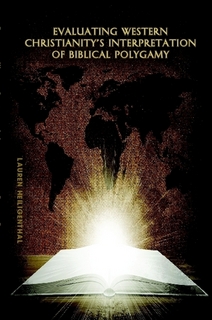
My book, Evaluating Western Christianity’s Interpretation of Biblical Polygamy, is officially available on my publisher’s website: http://www.patriarchpublishinghouse.com/9781629045214.htm. A copy is $9.95 plus S&H. If you live outside of the United States, this book can be shipped internationally.

For a summary of this book visit my post Finally Published!

If you’re interested in why I have chosen to write about biblical polygamy, please check out The Story Behind the Book.

If you have any questions, comments, or insights, I’d love to read them and dialogue with you 🙂

Denying Approval

My whole life I’ve sought approval, intentionally and unintentionally. I often place things in two categories: Failure or Accomplishment. My efforts in school have had a great impact on this mindset. I’ve always been determined to do my very best, and the reward of an “A” fell into the Accomplishment category. I based my success on my grades and teachers’ comments. I raised a high standard for myself, and I usually accomplished my goals. All of this sounds harmless enough, but I stressed out…A LOT. I always did my best and the results were usually high marks, but I still worried and stressed. You would think I would learn that stress was not necessary, but I just got into a routine of “how to do school work” (involving much stress) which transferred to undergraduate and graduate studies. I always wanted approval to know that I was doing everything right. It seemed like teachers and colleagues had more confidence in me than I did.

Because most of my life has been immersed in school, the idea of approval permeated other areas of my life: family, friendships, relationships, everyday tasks, etc. Any criticism from these and other areas I placed in the Failure category. If friendships or other relationships started to falter, I tried to make them work. I HAD to make them work. Failure (as I saw it) was not an option. You can probably guess that this didn’t work out too well for me. When God told me to make a big change in my life, I obeyed, but I still feared man. “How would my friends react?” “People won’t believe me.”  “They’re bringing accusations against me.” “My family doesn’t support me.” My focus has been on what people think rather than what God has asked me to do. Even in writing this blog, it becomes such a temptation to want tangible feedback. But God didn’t want me to start this blog for people’s approval, but rather to share His truth. So this is what I will share now.

Acts 3:1-4:31 is a profound example of what God requires from me and every other Christian who seeks to follow His will. I include the passage in full because sometimes a summary does not do Scripture justice:

3 “Now Peter and John were going up to the temple at the ninth hour, the hour of prayer. And a man who had been lame from his mother’s womb was being carried along, whom they used to set down every day at the gate of the temple which is called Beautiful, in order to beg alms of those who were entering the temple. When he saw Peter and John about to go into the temple, he began asking to receive alms. But Peter, along with John, fixed his gaze on him and said, ‘Look at us!’ And he began to give them his attention, expecting to receive something from them. But Peter said, ‘I do not possess silver and gold, but what I do have I give to you: In the name of Jesus Christ the Nazarene—walk!’ And seizing him by the right hand, he raised him up; and immediately his feet and his ankles were strengthened. With a leap he stood upright and began to walk; and he entered the temple with them, walking and leaping and praising God. And all the people saw him walking and praising God; 10 and they were taking note of him as being the one who used to sit at the Beautiful Gate of the temple to beg alms, and they were filled with wonder and amazement at what had happened to him.

11 While he was clinging to Peter and John, all the people ran together to them at the so-called portico of Solomon, full of amazement. 12 But when Peter saw this, he replied to the people, ‘Men of Israel, why are you amazed at this, or why do you gaze at us, as if by our own power or piety we had made him walk? 13 The God of Abraham, Isaac and Jacob, the God of our fathers, has glorified His servant Jesus, the one whom you delivered and disowned in the presence of Pilate, when he had decided to release Him. 14 But you disowned the Holy and Righteous One and asked for a murderer to be granted to you, 15 but put to death the Prince of life, the one whom God raised from the dead, a fact to which we are witnesses. 16 And on the basis of faith in His name, it is the name of Jesus which has strengthened this man whom you see and know; and the faith which comes through Him has given him this perfect health in the presence of you all. 17 And now, brethren, I know that you acted in ignorance, just as your rulers did also. 18 But the things which God announced beforehand by the mouth of all the prophets, that His Christ would suffer, He has thus fulfilled. 19 Therefore repent and return, so that your sins may be wiped away, in order that times of refreshing may come from the presence of the Lord; 20 and that He may send Jesus, the Christ appointed for you, 21 whom heaven must receive until the period of restoration of all things about which God spoke by the mouth of His holy prophets from ancient time. 22 Moses said, ‘The Lord God will raise up for you a prophet like me from your brethren; to Him you shall give heed to everything He says to you. 23 And it will be that every soul that does not heed that prophet shall be utterly destroyed from among the people.’ 24 And likewise, all the prophets who have spoken, from Samuel and his successors onward, also announced these days. 25 It is you who are the sons of the prophets and of the covenant which God made with your fathers, saying to Abraham, ‘And in your seed all the families of the earth shall be blessed.’ 26 For you first, God raised up His Servant and sent Him to bless you by turning every one of you from your wicked ways.’

As they were speaking to the people, the priests and the captain of the temple guard and the Sadducees came up to them, being greatly disturbed because they were teaching the people and proclaiming in Jesus the resurrection from the dead. And they laid hands on them and put them in jail until the next day, for it was already evening. But many of those who had heard the message believed; and the number of the men came to be about five thousand.

On the next day, their rulers and elders and scribes were gathered together in Jerusalem; and Annas the high priest was there, and Caiaphas and John and Alexander, and all who were of high-priestly descent. When they had placed them in the center, they began to inquire, ‘By what power, or in what name, have you done this?’ Then Peter, filled with the Holy Spirit, said to them, ‘Rulers and elders of the people, if we are on trial today for a benefit done to a sick man, as to how this man has been made well, 10 let it be known to all of you and to all the people of Israel, that by the name of Jesus Christ the Nazarene, whom you crucified, whom God raised from the dead—by this name this man stands here before you in good health. 11 He is the stone which was rejected by you, the builders, but which became the chief corner stone. 12 And there is salvation in no one else; for there is no other name under heaven that has been given among men by which we must be saved.’

13 Now as they observed the confidence of Peter and John and understood that they were uneducated and untrained men, they were amazed, and began to recognize them as having been with Jesus. 14 And seeing the man who had been healed standing with them, they had nothing to say in reply. 15 But when they had ordered them to leave the Council, they began to confer with one another, 16 saying, ‘What shall we do with these men? For the fact that a noteworthy miracle has taken place through them is apparent to all who live in Jerusalem, and we cannot deny it. 17 But so that it will not spread any further among the people, let us warn them to speak no longer to any man in this name.’ 18 And when they had summoned them, they commanded them not to speak or teach at all in the name of Jesus. 19 But Peter and John answered and said to them, ‘Whether it is right in the sight of God to give heed to you rather than to God, you be the judge; 20 for we cannot stop speaking about what we have seen and heard.’ 21 When they had threatened them further, they let them go (finding no basis on which to punish them) on account of the people, because they were all glorifying God for what had happened; 22 for the man was more than forty years old on whom this miracle of healing had been performed.

23 When they had been released, they went to their own companions and reported all that the chief priests and the elders had said to them. 24 And when they heard this, they lifted their voices to God with one accord and said, ‘O Lord, it is You who made the heaven and the earth and the sea, and all that is in them, 25 who by the Holy Spirit, through the mouth of our father David Your servant, said,

‘Why did the Gentiles rage,
And the peoples devise futile things?
26 ‘The kings of the earth took their stand,
And the rulers were gathered together
Against the Lord and against His Christ.’

27 For truly in this city there were gathered together against Your holy servant Jesus, whom You anointed, both Herod and Pontius Pilate, along with the Gentiles and the peoples of Israel, 28 to do whatever Your hand and Your purpose predestined to occur.29 And now, Lord, take note of their threats, and grant that Your bond-servants may speak Your word with all confidence, 30 while You extend Your hand to heal, and signs and wonders take place through the name of Your holy servant Jesus.’ 31 And when they had prayed, the place where they had gathered together was shaken, and they were all filled with the Holy Spirit and began to speak the word of God with boldness.” (Bold words added for emphasis)

John and Peter performed the amazing miracle of healing a man lame from birth, but they don’t take the credit. Instead, they use this moment as an opportunity to share Christ with all the Jews who are in awe of them. How many of us would have dismissed the adoration of these people? These Apostles teach us that Christ gets all the glory all of the time. Then the religious leaders hear about what’s happened. That’s right, the religious leaders are upset that these men are teaching about Jesus (keep in mind that the Sadducees don’t believe in the resurrection). Even though John and Peter were put in prison, about five thousand men had already believed their testimony about Christ. The following day a number of the religious “big wigs” were present to question these followers of Jesus, and again, Peter, through the power of the Holy Spirit, shared the message of Christ (just like Jesus said they would; Matt. 10:16-20). What is notable to me is that this Council, which is supposed to represent the experts of the Scriptures, cannot deny that a miracle has taken place, but they don’t want people following Jesus, the true Messiah. They tell John and Peter to no longer teach about Jesus. These Apostles could have listened to these authoritative men, but instead, they appealed to a higher authority, God Himself. They not only stood firm in their beliefs and convictions, but they questioned the Council’s own godliness, “Whether it is right in the sight of God to give heed to you rather than to God, you be the judge” (Acts 4:19). I think another way of conveying the same message is “If you think we should accept your approval above God’s, you be the judge.” These men knew what they were called to do. They knew the cost and chose Christ. They stood their ground with God backing them up, and the Council could do nothing to them because all of the people were glorifying God. If they turned against these Apostles, the people would turn on them. After all these things, the Apostles returned to their companions, and they gave all the glory to God. And when they asked the Lord for confidence and boldness, He gave it to them.

What a powerful story! It’s one that I try to remember every time I get discouraged about people’s attitudes and responses when I know I’m following God’s will. I try to remember it when I begin to doubt myself and focus on negative things. Living the Christian life is not about me or about other people’s approval. It’s about God. If I lose sight of that, it’s all for naught.

Acts 5:12-42 is another great passage about denying approval (right after God strikes down Ananias and Sapphira…yikes!):

12 At the hands of the apostles many signs and wonders were taking place among the people; and they were all with one accord in Solomon’s portico. 13 But none of the rest dared to associate with them; however, the people held them in high esteem. 14 And all the more believers in the Lord, multitudes of men and women, were constantly added to their number, 15 to such an extent that they even carried the sick out into the streets and laid them on cots and pallets, so that when Peter came by at least his shadow might fall on any one of them. 16 Also the people from the cities in the vicinity of Jerusalem were coming together, bringing people who were sick or afflicted with unclean spirits, and they were all being healed.

17 But the high priest rose up, along with all his associates (that is the sect of the Sadducees), and they were filled with jealousy. 18 They laid hands on the apostles and put them in a public jail. 19 But during the night an angel of the Lord opened the gates of the prison, and taking them out he said, 20 ‘Go, stand and speak to the people in the temple the whole message of this Life.’ 21 Upon hearing this, they entered into the temple about daybreak and began to teach.

Now when the high priest and his associates came, they called the Council together, even all the Senate of the sons of Israel, and sent orders to the prison house for them to be brought. 22 But the officers who came did not find them in the prison; and they returned and reported back, 23 saying, ‘We found the prison house locked quite securely and the guards standing at the doors; but when we had opened up, we found no one inside.’ 24 Now when the captain of the temple guard and the chief priests heard these words, they were greatly perplexed about them as to what would come of this. 25 But someone came and reported to them, ‘The men whom you put in prison are standing in the temple and teaching the people!’ 26 Then the captain went along with the officers and proceeded to bring them back without violence (for they were afraid of the people, that they might be stoned).

27 When they had brought them, they stood them before the Council. The high priest questioned them, 28 saying, ‘We gave you strict orders not to continue teaching in this name, and yet, you have filled Jerusalem with your teaching and intend to bring this man’s blood upon us.’ 29 But Peter and the apostles answered, ‘We must obey God rather than men. 30 The God of our fathers raised up Jesus, whom you had put to death by hanging Him on a cross. 31 He is the one whom God exalted to His right hand as a Prince and a Savior, to grant repentance to Israel, and forgiveness of sins. 32 And we are witnesses of these things; and so is the Holy Spirit, whom God has given to those who obey Him.’

33 But when they heard this, they were cut to the quick and intended to kill them. 34 But a Pharisee named Gamaliel, a teacher of the Law, respected by all the people, stood up in the Council and gave orders to put the men outside for a short time. 35 And he said to them, ‘Men of Israel, take care what you propose to do with these men. 36 For some time ago Theudas rose up, claiming to be somebody, and a group of about four hundred men joined up with him. But he was killed, and all who followed him were dispersed and came to nothing. 37 After this man, Judas of Galilee rose up in the days of the census and drew away some people after him; he too perished, and all those who followed him were scattered. 38 So in the present case, I say to you, stay away from these men and let them alone, for if this plan or action is of men, it will be overthrown; 39 but if it is of God, you will not be able to overthrow them; or else you may even be found fighting against God.’

40 They took his advice; and after calling the apostles in, they flogged them and ordered them not to speak in the name of Jesus, and then released them. 41 So they went on their way from the presence of the Council, rejoicing that they had been considered worthy to suffer shame for His name. 42 And every day, in the temple and from house to house, they kept right on teaching and preaching Jesus as the Christ.” (Bold print added for emphasis)

This story is very similar to the previous one, but this time it involves all of the Apostles. They’re performing miracles and teaching about Jesus as before, but this time we get some new information. The high priest and the Sadducees act out of jealousy. These followers of Jesus are doing what they cannot. More people are following the Apostles each day. So once again, they are thrown in jail. But God releases them with the command to continue teaching in the temple. And once again, while the Apostles could have acted out of fear of men, they feared God more and began to teach. The entire Council convenes to question these men and remind them that they have already been told to no longer teach in the name of Jesus. All of the Apostles respond: “We must obey God rather than men.” This could also read, “We seek God’s approval rather than man’s approval.” The Apostles then tell them about Christ…again. Do you realize how many chances these religious men have had to repent? How much patience God has with them? Even before Jesus’ death they are given plenty of opportunities to follow Christ. They’ve seen an abundance of miracles that demonstrate God’s power, and still they don’t give heed to the truth. While the Council is ready to kill the Apostles, Gamaliel, a Pharisee, appeases them with some wise advice. (It is important to note that this is the same Gamaliel who is believed to be Paul’s former teacher; Acts 22:3). He understands from history and reminds the Council that if plans are from men, they fail. But if they are from God, they cannot be overthrown. Even more seriously, those who fight against godly men may be found fighting against God Himself. While the high priest and the Sadducees only seem to adhere to their own authority, Gamaliel demonstrates his piety by not wanting to go against God’s will. In the end, the Apostles rejoice in their suffering for Christ’s sake and continue to do what the religious authorities told them not to.

I read these stories, and I have to ask myself a few questions: Am I as committed to Christ as the Apostles were? Am I willing to deny the approval of men when God tells me to do something? Instead of worrying, do I trust the Lord to give me the right words to say when I stand accused? Am I humble enough to give all the glory to God? Insert your own questions here.

My hope should be in Christ. My confidence should be in Him. My trust should be in the Lord who gives boldness when His children ask for it.

In Psalm 27, David’s beautiful writing shares these same thoughts:

“:1 The Lord is my light and my salvation;
Whom shall I fear?
The Lord is the defense of my life;
Whom shall I dread?
When evildoers came upon me to devour my flesh,
My adversaries and my enemies, they stumbled and fell.
Though a host encamp against me,
My heart will not fear;
Though war arise against me,
In spite of this I shall be confident.

One thing I have asked from the Lord, that I shall seek:
That I may dwell in the house of the Lord all the days of my life,
To behold the beauty of the Lord
And to meditate in His temple.
For in the day of trouble He will conceal me in His tabernacle;
In the secret place of His tent He will hide me;
He will lift me up on a rock.
And now my head will be lifted up above my enemies around me,
And I will offer in His tent sacrifices with shouts of joy;
I will sing, yes, I will sing praises to the Lord.

Hear, O Lord, when I cry with my voice,
And be gracious to me and answer me.
When You said, ‘Seek My face,’ my heart said to You,
‘Your face, O Lord, I shall seek.’
Do not hide Your face from me,
Do not turn Your servant away in anger;
You have been my help;
Do not abandon me nor forsake me,
O God of my salvation!
10 For my father and my mother have forsaken me,
But the Lord will take me up.

11 Teach me Your way, O Lord,
And lead me in a level path
Because of my foes.
12 Do not deliver me over to the desire of my adversaries,
For false witnesses have risen against me,
And such as breathe out violence.
13 I would have despaired unless I had believed that I would see the goodness of the Lord
In the land of the living.
14 Wait for the Lord;
Be strong and let your heart take courage;
Yes, wait for the Lord.”

All Scriptural passages are from the NASB.

© Lauren Heiligenthal
 

The Story Behind the Book

Polygamy.[1] This word often conjures up negative thoughts, images, and stories told throughout the years. The Western world most likely identifies polygamy with Mormonism and the tragedies therein. It seems as though these tragedies have defined what polygamy is all about, but is this generalization really fair? Before you misunderstand me, I am NOT (nor ever have been) a Mormon nor do I agree with the tenets of Mormonism. Rather, my interest in polygamy derives from my love of missions.

Because of the negativity surrounding polygamy in the Western world, people’s perceptions and feelings often get inserted into Scriptural depictions of polygamy. Growing up in the church, I was taught that God simply tolerated polygamy practiced by the biblical patriarchs. This “toleration” led me to believe that polygamy was indeed a sin, but for some reason God just let it go. The impression I got from this teaching was that these patriarchs were righteous men who happened to make mistakes along the way. But one question remained in my heart: Does God really tolerate sin to the point of not saying ANYTHING? It wasn’t until much later that I reevaluated this thought process.

I started participating in short-term mission trips around 11 years old. In the following years, my passion and heart grew for missions as I traveled to Hungary, Romania, Thailand, Peru, and South Africa. I met amazing people who had a heart and hunger for the truth. I pursued a degree in Intercultural Studies because it has been God’s desire for me to be a missionary. In learning how to approach another culture and teach the Gospel, the subject of polygamy would come up from time to time. I wrestled with the question, What would I do? Can I justify teaching people to split up their families because they’re in sin? On the flip side, can I live with teaching people how to live a Christian life while still living in sin? It seemed like there was no good outcome to either of these questions. As soon as I would ponder this dilemma, I pushed it off and moved onto something else. It wasn’t until I was sitting in a Cultural Anthropology class during my undergraduate studies that I was confronted with these same questions.

My professor must have been talking about different family structures one day (I don’t exactly remember), and he commented that he didn’t think Scripture teaches against polygamy. I had never heard anyone say this before. This went completely against what I had been taught, and I questioned him, What about this Scripture? What about that Scripture? He gave me some responses, but he didn’t have much to say. He mainly was just giving the class his opinion. Within this discussion he commented how polygamous families coming to America were often forced to divorce because of our laws, and my professor didn’t agree with that. He also shared one story in particular that caught my attention.

Years ago his parents were missionaries in Western Africa. His parents were planting a new church and needed funding for a new building. A polygamist offered to pay for the project (polygamists tend to have more wealth which they need to take care of their larger families), and apparently my professor’s parents agreed. However, when it came time for services to begin, the missionaries wouldn’t allow the polygamist to participate unless he was no longer a polygamist. As I listened, I could tell that my professor was not pleased with his parents’ decision, and I began to wonder a few things myself. Why did they offer to let the man pay the expenses if they didn’t agree with his lifestyle? Because they accepted his money, how could they justify excluding him from the body? What kind of message did this send to the rest of the village? How could they encourage divorce in order to participate in the body of Christ? At this point, I couldn’t let the polygamy dilemma go. There had to be a biblical course of action.

I decided to take a fresh look at Scripture again and found that there is, indeed, no prohibition of polygamy. There are regulations concerning polygamy in the Law, and there are a number of narratives involving polygamy, but there is no prohibition. On the contrary, there are a few passages that seem to indicate God’s involvement rather than a simple toleration. For example, in 2 Samuel 12 Nathan confronts David about his sins of adultery and murder. Pay attention to what the Lord says through Nathan in vv. 7-8, “Nathan then said to David, “You are the man! Thus says the Lord God of Israel, ‘It is I who anointed you king over Israel and it is I who delivered you from the hand of Saul. I also gave you your master’s house and your master’s wives into your care, and I gave you the house of Israel and Judah; and if that had been too little, I would have added to you many more things like these!’” (Bold words added for emphasis). God Himself tells David that it was He who gave him Saul’s wives. If the things God had given David were too little (this includes wives), He would have given him more. If polygamy was contrary to God’s divine plan for marriage, it does not make sense for Him to offer more wives to David. Also, if you read through the rest of that passage (vv. 9-23), you will find that God’s punishment of David and his household had nothing to do with polygamy, but rather it was because David committed adultery with Bathsheba and murdered her husband.

Another example is Genesis 29:31-30:24. It would take too long to discuss this passage in length (I discuss it in my book), but I bring it up to make you aware of how much God is involved in the growth of Jacob’s family. He opens Leah’s womb (Gen. 29:31), and she initially bears four sons. When she names them she praises the Lord for hearing and seeing her in her affliction. God is perceived as the One blessing her. When Rachel remains barren she gives her handmaid to Jacob, and the children that Bilhah bears become Rachel’s children. Leah also does the same thing when she stops childbearing and gives her handmaid, Zilpah, to Jacob. The wives themselves make this choice. Jacob does not simply take for himself (This is similar to Abraham’s story when Sarah gives Hagar to him). When Leah bears again in v. 17, she exclaims in v. 18, “God has given me my wages because I gave my maid to my husband.” Again, God is constantly perceived as being involved in childbearing. Then it’s Rachel’s turn. Verse 22 says, “Then God remembered Rachel, and God gave heed to her and opened her womb.” Some scholars argue that the language used to describe God’s involvement is just simply how the people viewed their situation. It’s not really what was going on. However, if we follow this kind of logic then we would have to doubt all of Scripture. With this same logic, every Christian perceives that he/she is saved because of Jesus’ sacrifice, but this is not necessarily true. This is just what we want to believe. Now, we would argue that such a conclusion is false. So why is it that people assume that the OT is only a perception of truth but not a representation of truth itself? I hold to the belief that when Scripture indicates God’s involvement, He was truly involved. You can make your own conclusions.

In 1 Samuel 1 God blesses Hannah, one of Elkanah’s wives, with a son (Samuel) whom she dedicates to the Lord. This man becomes an important prophet in Israel’s history. In 2 Chronicles 24:3, Jehoiada (a righteous priest) takes two wives for young king Joash. Again, if a person is deemed righteous, it does not make sense to say that their actions are sinful unless they are noted as such.

One of the most eye-opening passages of Scripture in my study of polygamy is Ezekiel 23. In this passage, the Lord (through Ezekiel) allegorizes the sins that Judah and Samaria have committed against Him. Let’s take a look at vv. 1-4, “The word of the Lord came to me again, saying, ‘Son of man, there were two women, the daughters of one mother;  and they played the harlot in Egypt. They played the harlot in their youth; there their breasts were pressed and there their virgin bosom was handled. Their names were Oholah the elder and Oholibah her sister. And they became Mine, and they bore sons and daughters. And as for their names, Samaria is Oholah and Jerusalem is Oholibah’” (Bold print added for emphasis). Now, I am fully aware that this is NOT saying that the Lord is literally married to Judah and Samaria. The text is obviously allegorical to convey their abhorrent acts (continue reading the rest of the chapter). However, I am proposing that the Lord would not use a sinful depiction to describe Himself. The text explains how Oholah and Oholibah have committed adultery against the Lord. The only way for a woman to commit adultery against a man is if she’s married to him. In this context, it seems that God has depicted Himself as a polygamous husband to two women (Judah and Samaria) who eventually commit adultery against Him. Therefore, I have asked myself, If polygamy is sinful, why would God describe Himself in this manner? If God describes Himself as a polygamous husband in the OT, it does not make sense to say that polygamy is a sin in the OT. As such, since God is both omniscient and immutable, it stands to reason that polygamy is not a sin in the NT. If I choose to believe otherwise, I fear that I would be questioning God’s nature.

I understand that polygamy is a taboo topic, but the main question I have had to ask myself is: Does the Bible prohibit polygamy, or is it my culture’s prohibition of polygamy that gets inserted into biblical interpretation and the text itself? This question is not only relevant for polygamy, but for any topic. I am accountable for what I hear, read, teach, and believe. If I don’t take the time to understand what Scripture has to say about polygamy (or not say), my decisions (particularly on the mission field) and interpretations can continue to have a negative impact on cultures that practice polygamy. In many cases over the last 100+ years, missionaries have either suggested or demanded that polygamous husbands divorce all but their first wife if they want to be baptized or participate at all in the church. This has led to devastating results. Some wives have had no other option than to become prostitutes to take care of themselves. In a number of these cultures most men do not want to marry a divorced woman (divorce is often viewed as dishonorable), which is quite a foreign concept for Western societies. Divorce also has a negative impact on children who are either torn from their father and live with their poor mother (and possibly her extended family) or are torn from their mothers and live with their father. I’m not writing this to be condemning, but rather to illustrate that if we interpret Scripture based on our cultural values rather than biblically-founded values, there may be serious consequences. People have already interpreted Scripture in this way about divorce, abortion, homosexuality, promiscuity, etc. In this present age, Scripture has become whatever we want it to say, and this mindset carries many dangers.

I’ve done more research besides what I’ve discussed here, but I wanted to give you an inside look into some of my thoughts and questions. I also hope that I’ve challenged you somehow. Please feel free to ask a question or give a comment.

~~~~~~~~~~~~~~~

I’ll keep you updated on book news once I receive it from my publisher.

Feel free to check out http://www.lulu.com/shop/lauren-heiligenthal/evaluating-western-christianitys-interpretation-of-biblical-polygamy/paperback/product-21877418.html. It appears that you have to be registered with lulu.com to buy my book if you’re interested.

My publisher’s website is http://www.patriarchpublishinghouse.com/. My book should appear on this website soon. Also, they have many other books on polygamy and patriarchy if these topics interest you.

Footnote

[1] I am specifically referring to polygyny, which is one man having multiple wives. I focus on this form of polygamous marriage because it is demonstrated in Scripture and appears to be an acceptable form of marriage. Other forms of polygamy, such as polyandry (one woman with multiple husbands), polyamory (multiple relationships at the same time), and polygynandry (multiple husbands and wives in an intertwining of relationships), are not demonstrated in Scripture. I believe they are considered sinful because polyandry and polygynandry result in adultery. Polyamory could involve adultery, but it is also a demonstration of blatant sexual promiscuity.

© Lauren Heiligenthal

Finally Published!

Some of you may have read my “About Me” section which mentions that I’ve had a book in the works. The day has finally come, and now it’s available for sale 🙂 The book is called Evaluating Western Christianity’s Interpretation of Biblical Polygamy. Yes, I imagine that most people will find this a controversial topic, and I plan on explaining the back story in an upcoming post. However, today I will simply include the summary of the book to whet your appetite:

“This book demonstrates that the popular Western worldview regarding marriage affects biblical interpretation. While most Western societies uphold monogamy as God’s ideal form of marriage, a number of other cultures practice polygamy. Western Christianity often perceives polygamy as a threat to the monogamist ideal; therefore, this book evaluates whether the Bible clearly advocates that polygamous men should become monogamous through divorce. The majority of the evaluative process focuses on five biblical texts that many scholars frequently use to oppose polygamy. Most of their arguments stem from Gen. 2:20-24 because God creates one woman for Adam, thereby instituting the monogamist ideal for all people. This interpretation is then transferred to other texts, including Gen. 30:1-24, Matt. 19:3-9, 1 Tim. 3:2, 12, and Titus 1:6. This book assesses the opposing arguments by exposing assumptions and potential biases, and also by reviewing the historical and social concepts of marriage in the Ancient Near Eastern and the Greco-Roman periods. After interpreting Scripture through the lens of the biblical audience, this book then applies the interpretations from the five biblical texts to a modern situation involving polygamy. Since there is no biblical text that explicitly prohibits polygamy or promotes monogamy, this book argues that the interpretation of the monogamist ideal tends to derive from one’s worldview rather than the Bible.”

The book is currently being sold at http://www.lulu.com/shop/lauren-heiligenthal/evaluating-western-christianitys-interpretation-of-biblical-polygamy/paperback/product-21877418.html.

I would also like to draw your attention to my publisher’s website http://www.patriarchpublishinghouse.com/ which should have the book listed at some point. You can also visit the publisher’s blog at http://patriarchsjournal.wordpress.com/ for more information on this topic.

© Lauren Heiligenthal