Wives, Submit to Your Husbands

I can already sense the raised eyebrows and crossed arms. Submit?! We can often handle the word “respect” but “submit” is too much. However, this way of thinking is not Spirit-inspired but rather culture-inspired. In Western cultures, it is rare to hear anyone in society support the notion of hierarchy and submission within the home. And if we’re honest, the church has done a poor job teaching Scripture’s truth on the roles of men and women in the home and in the church. I would argue that the majority of the church has succumbed to culture’s viewpoint rather than the Lord’s. So what is the Lord’s will for the church and our families?

Creation is where everything began for humanity. Genesis 1:26-30 provides a general overview of the creation of man and how we were made in the image of God. We were created male and female and were given dominion over the earth and commanded to be fruitful and multiply. God created all that we would need to survive. Genesis 2 gives us a bit more detail on the creation of man. In verse 7 we read that God formed man from the dust of the earth, breathed life into him, and set him in the garden that He created for man to cultivate. But the Lord saw that it was not good for man to be alone (v. 18) so He decided to make a helper suitable for him. Nothing in creation was suitable for Adam so that Lord caused Adam to fall into a deep sleep. He took one of his ribs and created Woman from it (vv. 21-22). Verses 23 and 24 state:

“The man said,

‘This is now bone of my bones,
And flesh of my flesh;
She shall be called Woman,
Because she was taken out of Man.’

For this reason a man shall leave his father and his mother, and be joined to his wife; and they shall become one flesh.”

We cannot deny from these passages that God created Adam first, and Eve was created from a part of him. We are unique from the rest of creation in a number of ways, but I believe this facet is one of the most striking. Man and woman are joined physically in bone and flesh hence the phrase “they shall become one flesh” in verse 24. 

Fast-forward thousands of years to the time of the early church. In Ephesians 5, Paul writes about relationships, and specifically in verses 22-33, he writes about husbands and wives. I have heard professors and preachers use verse 21 to promote mutual submission between husband and wife because it says, “and be subject to one another in the fear of Christ.” If that was the end of the discussion, I could see how this would lead to the idea of mutual submission. But the rest of Paul’s message provides an explanation to verse 21. Let’s read vv. 22-33:

“Wives, be subject to your own husbands, as to the Lord. For the husband is the head of the wife, as Christ also is the head of the church, He Himself being the Savior of the body. But as the church is subject to Christ, so also the wives ought to be to their husbands in everything. Husbands, love your wives, just as Christ also loved the church and gave Himself up for her, so that He might sanctify her, having cleansed her by the washing of water with the word, that He might present to Himself the church in all her glory, having no spot or wrinkle or any such thing; but that she would be holy and blameless. So husbands ought also to love their own wives as their own bodies. He who loves his own wife loves himself; for no one ever hated his own flesh, but nourishes and cherishes it, just as Christ also does the church, because we are members of His body. For this reason a man shall leave his father and mother and shall be joined to his wife, and the two shall become one flesh. This mystery is great; but I am speaking with reference to Christ and the church. Nevertheless, each individual among you also is to love his own wife even as himself, and the wife must see to it that she respects her husband.”

What I love about this passage is how marriage is compared to the relationship between Christ and the church because it shows what love should look like and leaves no room to doubt that there is a hierarchy within the home. In explanation to verse 21, wives are instructed to be subject to their own husbands. In plain language, Paul explains that the husband is head of the wife as Christ is the head of the church. The church subjects itself to Christ; therefore, the wife is to subject herself to her husband. We wouldn’t say that Christ submits to the church so why do we say that husbands should submit to their wives? Scripture clearly denies this notion. Rather, it should be noted that husbands have a bit more instruction than the wives do because they are to emulate Christ and His love for the church. They ought to love their wives as their own bodies (going back to the creation account in Genesis) and to love sacrificially as Christ did, giving Himself up for the sake of the church. Husbands are given great responsibility in regards to their wives and families. In the same way we submit to Christ because of the love He has demonstrated to us, wives also ought to submit to their husbands. 

As we know, no marriage or relationship is perfect. We are sinful beings striving to live righteously in a sinful world. Peter writes to the church in 1 Peter 3:1-7:

“In the same way, you wives, be submissive to your own husbands so that even if any of them are disobedient to the word, they may be won without a word by the behavior of their wives, as they observe your chaste and respectful behavior. Your adornment must not be merely external—braiding the hair, and wearing gold jewelry, or putting on dresses; but let it be the hidden person of the heart, with the imperishable quality of a gentle and quiet spirit, which is precious in the sight of God. For in this way in former times the holy women also, who hoped in God, used to adorn themselves, being submissive to their own husbands; just as Sarah obeyed Abraham, calling him lord, and you have become her children if you do what is right without being frightened by any fear. You husbands in the same way, live with your wives in an understanding way, as with someone weaker, since she is a woman; and show her honor as a fellow heir of the grace of life, so that your prayers will not be hindered.”

Again, I want to reiterate that Peter, just like Paul, is writing to the church. They are instructions for believers and are not condoning abuse in any way. Rather, if a woman’s husband is not in right-standing with God, she’s not being told to point her finger at him and remind him of his faults as our culture often demonstrates. Instead, it is his wife’s behavior- respectful, gentle, quiet, modest- that can help him turn back to God. No words need to be said. We are not supposed to be self-seeking, boisterous, gossiping, nagging women. Often people get bent out of shape when they read “live with your wives in an understanding way, as with someone weaker, since she is a woman.” It is not meant to cause offense, but in truth, emotionally and physically we are weaker. We are led too often by emotions rather than wisdom, which can bleed into how we walk spiritually. When people continue reading, they would see that a husband’s behavior towards his wife is important for his own spiritual life: “show her honor as a fellow heir of the grace of life, so that your prayers will not be hindered.” That’s quite a powerful statement. If a husband is not doing his part in caring for his wife and being the spiritual leader that he’s meant to be, God may not give heed to his prayers until the situation has been reconciled. Husbands and wives are both responsible to fulfill their God-given roles. 

It’s easy to laugh at comedians who talk about husbands fearing their wives because of their many moods and whims. We even hear such quips from the pulpit. We laugh because we see this behavior in our own lives. As the church, our relationships are often not reflections of Scripture but of the world. If wives are not submitting to and respecting their husbands as the head of their household and husbands are not loving and caring for their wives like Christ loves the church, why should we expect God to move in our families and in the church? What example are we setting for non-believers when our lives look just like theirs? How many marriages have ended in failure and how much of that could’ve been prevented just by following God’s Word? Wives, it is not our job to be the spiritual head of the household. It isn’t. Should we pray? Absolutely! Should we cover our husband and children in prayer? Yes! Should we be in the Word and lead by example? Yes! But men in our culture have been told that they’re toxic and that they’re unwanted and not needed. They have been emasculated by the media, politics, and yes, even the church. So how can we expect them to be leaders when they’re told just the opposite? We need men like Abraham, Isaac, Jacob, Moses, David, etc. They were not perfect, but they strived to be men of God, leading the people of Israel in strength and righteousness. Isn’t that the kind of husband you want leading your family? As women, don’t we want to honor God by how we treat our husbands? We have to stop caring if the world is offended by our behavior and get our hearts, minds, and attitudes back to the truth of God’s Word. 

The world needs to see real love. Christ is the ultimate demonstration of that love, and our marriages should be a reflection of Christ’s love to His bride.

© Lauren Demuth

Serial Polygamy

Thought this was insightful for people of Western culture. Divorce and remarriage have become normalized, but how do they affect families who have to experience them versus households that may have multiple spouses and children and they’re all taken care of? It’s important to analyze our own cultural decisions and observe other cultural practices in light of Scripture. In judging too quickly, we might miss something.

SandreS's avatarThe Patriarchs' Journal

In some societies a man may marry several wives. Western society allows this in a different way, in what is sometimes called “serial polygamy” – a man may marry several wives so long as he legally divorces the current one before marrying the next.

Arguably, the “Christian” form of polygamy is a more primitive and callous arrangement for the man’s existing family than ordinary polygamy. In polygamous societies, the first wife and their children remain viable parts of a viable social entity… In serial polygamy the children are brought up in a broken home, the wife is discarded in a difficult social position.

Understanding Human Behavior
Human Relationships: Man & His Women, Vol. 4, p. 438

View original post

Book Update

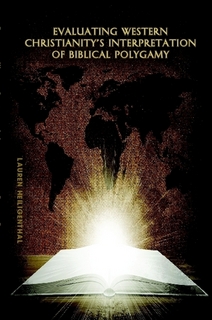
My book, Evaluating Western Christianity’s Interpretation of Biblical Polygamy, is officially available on my publisher’s website: http://www.patriarchpublishinghouse.com/9781629045214.htm. A copy is $9.95 plus S&H. If you live outside of the United States, this book can be shipped internationally.

For a summary of this book visit my post Finally Published!

If you’re interested in why I have chosen to write about biblical polygamy, please check out The Story Behind the Book.

If you have any questions, comments, or insights, I’d love to read them and dialogue with you 🙂

The Story Behind the Book

Polygamy.[1] This word often conjures up negative thoughts, images, and stories told throughout the years. The Western world most likely identifies polygamy with Mormonism and the tragedies therein. It seems as though these tragedies have defined what polygamy is all about, but is this generalization really fair? Before you misunderstand me, I am NOT (nor ever have been) a Mormon nor do I agree with the tenets of Mormonism. Rather, my interest in polygamy derives from my love of missions.

Because of the negativity surrounding polygamy in the Western world, people’s perceptions and feelings often get inserted into Scriptural depictions of polygamy. Growing up in the church, I was taught that God simply tolerated polygamy practiced by the biblical patriarchs. This “toleration” led me to believe that polygamy was indeed a sin, but for some reason God just let it go. The impression I got from this teaching was that these patriarchs were righteous men who happened to make mistakes along the way. But one question remained in my heart: Does God really tolerate sin to the point of not saying ANYTHING? It wasn’t until much later that I reevaluated this thought process.

I started participating in short-term mission trips around 11 years old. In the following years, my passion and heart grew for missions as I traveled to Hungary, Romania, Thailand, Peru, and South Africa. I met amazing people who had a heart and hunger for the truth. I pursued a degree in Intercultural Studies because it has been God’s desire for me to be a missionary. In learning how to approach another culture and teach the Gospel, the subject of polygamy would come up from time to time. I wrestled with the question, What would I do? Can I justify teaching people to split up their families because they’re in sin? On the flip side, can I live with teaching people how to live a Christian life while still living in sin? It seemed like there was no good outcome to either of these questions. As soon as I would ponder this dilemma, I pushed it off and moved onto something else. It wasn’t until I was sitting in a Cultural Anthropology class during my undergraduate studies that I was confronted with these same questions.

My professor must have been talking about different family structures one day (I don’t exactly remember), and he commented that he didn’t think Scripture teaches against polygamy. I had never heard anyone say this before. This went completely against what I had been taught, and I questioned him, What about this Scripture? What about that Scripture? He gave me some responses, but he didn’t have much to say. He mainly was just giving the class his opinion. Within this discussion he commented how polygamous families coming to America were often forced to divorce because of our laws, and my professor didn’t agree with that. He also shared one story in particular that caught my attention.

Years ago his parents were missionaries in Western Africa. His parents were planting a new church and needed funding for a new building. A polygamist offered to pay for the project (polygamists tend to have more wealth which they need to take care of their larger families), and apparently my professor’s parents agreed. However, when it came time for services to begin, the missionaries wouldn’t allow the polygamist to participate unless he was no longer a polygamist. As I listened, I could tell that my professor was not pleased with his parents’ decision, and I began to wonder a few things myself. Why did they offer to let the man pay the expenses if they didn’t agree with his lifestyle? Because they accepted his money, how could they justify excluding him from the body? What kind of message did this send to the rest of the village? How could they encourage divorce in order to participate in the body of Christ? At this point, I couldn’t let the polygamy dilemma go. There had to be a biblical course of action.

I decided to take a fresh look at Scripture again and found that there is, indeed, no prohibition of polygamy. There are regulations concerning polygamy in the Law, and there are a number of narratives involving polygamy, but there is no prohibition. On the contrary, there are a few passages that seem to indicate God’s involvement rather than a simple toleration. For example, in 2 Samuel 12 Nathan confronts David about his sins of adultery and murder. Pay attention to what the Lord says through Nathan in vv. 7-8, “Nathan then said to David, “You are the man! Thus says the Lord God of Israel, ‘It is I who anointed you king over Israel and it is I who delivered you from the hand of Saul. I also gave you your master’s house and your master’s wives into your care, and I gave you the house of Israel and Judah; and if that had been too little, I would have added to you many more things like these!’” (Bold words added for emphasis). God Himself tells David that it was He who gave him Saul’s wives. If the things God had given David were too little (this includes wives), He would have given him more. If polygamy was contrary to God’s divine plan for marriage, it does not make sense for Him to offer more wives to David. Also, if you read through the rest of that passage (vv. 9-23), you will find that God’s punishment of David and his household had nothing to do with polygamy, but rather it was because David committed adultery with Bathsheba and murdered her husband.

Another example is Genesis 29:31-30:24. It would take too long to discuss this passage in length (I discuss it in my book), but I bring it up to make you aware of how much God is involved in the growth of Jacob’s family. He opens Leah’s womb (Gen. 29:31), and she initially bears four sons. When she names them she praises the Lord for hearing and seeing her in her affliction. God is perceived as the One blessing her. When Rachel remains barren she gives her handmaid to Jacob, and the children that Bilhah bears become Rachel’s children. Leah also does the same thing when she stops childbearing and gives her handmaid, Zilpah, to Jacob. The wives themselves make this choice. Jacob does not simply take for himself (This is similar to Abraham’s story when Sarah gives Hagar to him). When Leah bears again in v. 17, she exclaims in v. 18, “God has given me my wages because I gave my maid to my husband.” Again, God is constantly perceived as being involved in childbearing. Then it’s Rachel’s turn. Verse 22 says, “Then God remembered Rachel, and God gave heed to her and opened her womb.” Some scholars argue that the language used to describe God’s involvement is just simply how the people viewed their situation. It’s not really what was going on. However, if we follow this kind of logic then we would have to doubt all of Scripture. With this same logic, every Christian perceives that he/she is saved because of Jesus’ sacrifice, but this is not necessarily true. This is just what we want to believe. Now, we would argue that such a conclusion is false. So why is it that people assume that the OT is only a perception of truth but not a representation of truth itself? I hold to the belief that when Scripture indicates God’s involvement, He was truly involved. You can make your own conclusions.

In 1 Samuel 1 God blesses Hannah, one of Elkanah’s wives, with a son (Samuel) whom she dedicates to the Lord. This man becomes an important prophet in Israel’s history. In 2 Chronicles 24:3, Jehoiada (a righteous priest) takes two wives for young king Joash. Again, if a person is deemed righteous, it does not make sense to say that their actions are sinful unless they are noted as such.

One of the most eye-opening passages of Scripture in my study of polygamy is Ezekiel 23. In this passage, the Lord (through Ezekiel) allegorizes the sins that Judah and Samaria have committed against Him. Let’s take a look at vv. 1-4, “The word of the Lord came to me again, saying, ‘Son of man, there were two women, the daughters of one mother;  and they played the harlot in Egypt. They played the harlot in their youth; there their breasts were pressed and there their virgin bosom was handled. Their names were Oholah the elder and Oholibah her sister. And they became Mine, and they bore sons and daughters. And as for their names, Samaria is Oholah and Jerusalem is Oholibah’” (Bold print added for emphasis). Now, I am fully aware that this is NOT saying that the Lord is literally married to Judah and Samaria. The text is obviously allegorical to convey their abhorrent acts (continue reading the rest of the chapter). However, I am proposing that the Lord would not use a sinful depiction to describe Himself. The text explains how Oholah and Oholibah have committed adultery against the Lord. The only way for a woman to commit adultery against a man is if she’s married to him. In this context, it seems that God has depicted Himself as a polygamous husband to two women (Judah and Samaria) who eventually commit adultery against Him. Therefore, I have asked myself, If polygamy is sinful, why would God describe Himself in this manner? If God describes Himself as a polygamous husband in the OT, it does not make sense to say that polygamy is a sin in the OT. As such, since God is both omniscient and immutable, it stands to reason that polygamy is not a sin in the NT. If I choose to believe otherwise, I fear that I would be questioning God’s nature.

I understand that polygamy is a taboo topic, but the main question I have had to ask myself is: Does the Bible prohibit polygamy, or is it my culture’s prohibition of polygamy that gets inserted into biblical interpretation and the text itself? This question is not only relevant for polygamy, but for any topic. I am accountable for what I hear, read, teach, and believe. If I don’t take the time to understand what Scripture has to say about polygamy (or not say), my decisions (particularly on the mission field) and interpretations can continue to have a negative impact on cultures that practice polygamy. In many cases over the last 100+ years, missionaries have either suggested or demanded that polygamous husbands divorce all but their first wife if they want to be baptized or participate at all in the church. This has led to devastating results. Some wives have had no other option than to become prostitutes to take care of themselves. In a number of these cultures most men do not want to marry a divorced woman (divorce is often viewed as dishonorable), which is quite a foreign concept for Western societies. Divorce also has a negative impact on children who are either torn from their father and live with their poor mother (and possibly her extended family) or are torn from their mothers and live with their father. I’m not writing this to be condemning, but rather to illustrate that if we interpret Scripture based on our cultural values rather than biblically-founded values, there may be serious consequences. People have already interpreted Scripture in this way about divorce, abortion, homosexuality, promiscuity, etc. In this present age, Scripture has become whatever we want it to say, and this mindset carries many dangers.

I’ve done more research besides what I’ve discussed here, but I wanted to give you an inside look into some of my thoughts and questions. I also hope that I’ve challenged you somehow. Please feel free to ask a question or give a comment.

~~~~~~~~~~~~~~~

I’ll keep you updated on book news once I receive it from my publisher.

Feel free to check out http://www.lulu.com/shop/lauren-heiligenthal/evaluating-western-christianitys-interpretation-of-biblical-polygamy/paperback/product-21877418.html. It appears that you have to be registered with lulu.com to buy my book if you’re interested.

My publisher’s website is http://www.patriarchpublishinghouse.com/. My book should appear on this website soon. Also, they have many other books on polygamy and patriarchy if these topics interest you.

Footnote

[1] I am specifically referring to polygyny, which is one man having multiple wives. I focus on this form of polygamous marriage because it is demonstrated in Scripture and appears to be an acceptable form of marriage. Other forms of polygamy, such as polyandry (one woman with multiple husbands), polyamory (multiple relationships at the same time), and polygynandry (multiple husbands and wives in an intertwining of relationships), are not demonstrated in Scripture. I believe they are considered sinful because polyandry and polygynandry result in adultery. Polyamory could involve adultery, but it is also a demonstration of blatant sexual promiscuity.

© Lauren Heiligenthal

Finally Published!

Some of you may have read my “About Me” section which mentions that I’ve had a book in the works. The day has finally come, and now it’s available for sale 🙂 The book is called Evaluating Western Christianity’s Interpretation of Biblical Polygamy. Yes, I imagine that most people will find this a controversial topic, and I plan on explaining the back story in an upcoming post. However, today I will simply include the summary of the book to whet your appetite:

“This book demonstrates that the popular Western worldview regarding marriage affects biblical interpretation. While most Western societies uphold monogamy as God’s ideal form of marriage, a number of other cultures practice polygamy. Western Christianity often perceives polygamy as a threat to the monogamist ideal; therefore, this book evaluates whether the Bible clearly advocates that polygamous men should become monogamous through divorce. The majority of the evaluative process focuses on five biblical texts that many scholars frequently use to oppose polygamy. Most of their arguments stem from Gen. 2:20-24 because God creates one woman for Adam, thereby instituting the monogamist ideal for all people. This interpretation is then transferred to other texts, including Gen. 30:1-24, Matt. 19:3-9, 1 Tim. 3:2, 12, and Titus 1:6. This book assesses the opposing arguments by exposing assumptions and potential biases, and also by reviewing the historical and social concepts of marriage in the Ancient Near Eastern and the Greco-Roman periods. After interpreting Scripture through the lens of the biblical audience, this book then applies the interpretations from the five biblical texts to a modern situation involving polygamy. Since there is no biblical text that explicitly prohibits polygamy or promotes monogamy, this book argues that the interpretation of the monogamist ideal tends to derive from one’s worldview rather than the Bible.”

The book is currently being sold at http://www.lulu.com/shop/lauren-heiligenthal/evaluating-western-christianitys-interpretation-of-biblical-polygamy/paperback/product-21877418.html.

I would also like to draw your attention to my publisher’s website http://www.patriarchpublishinghouse.com/ which should have the book listed at some point. You can also visit the publisher’s blog at http://patriarchsjournal.wordpress.com/ for more information on this topic.

© Lauren Heiligenthal