Hey everyone, check out my book Evaluating Western Christianity’s Interpretation of Biblical Polygamy for FREE February 6-8 on Amazon! Feel free to ask questions or leave comments on here or on Amazon. Enjoy 🙂
Free Book Promotion!
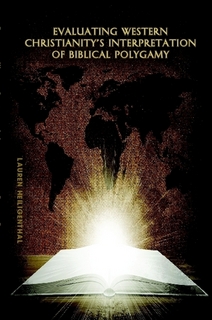
Hey everyone, check out my book Evaluating Western Christianity’s Interpretation of Biblical Polygamy for FREE February 6-8 on Amazon! Feel free to ask questions or leave comments on here or on Amazon. Enjoy 🙂
Just sending a reminder that my book sale on Amazon starts today and ends on the 31st. The Kindle edition is only 99 cents! Please check out End of January BOOK SALE! for more details.
My book, Evaluating Western Christianity’s Interpretation of Biblical Polygamy, will be on sale for .99 cents (kindle version) from January 25th-31st. If you have Kindle Unlimited, this book is always free to read!
Why should you consider buying it? The topic of polygamy has become more popular over the last few years, and it’s important to understand what the Bible says versus what the world says. There are different forms of polygamy, but there is only one form that the Bible illustrates and, I believe, is approved by God. This is a controversial subject that the church will no longer be able to push aside.
For more information about this book please visit my blog posts Finally Published! and The Story Behind the Book.
If you have any questions, comments, or simply want to have a discussion about this topic, please leave a comment below or send a message.
God bless!
From October 10th through the 17th the Kindle version of Evaluating Western Christianity’s Interpretation of Biblical Polygamy will be available for just .99 cents! It’s also available for free with Kindle Unlimited.
I would love to receive your thoughts, questions and comments on this controversial topic, or if you feel so inclined, to leave a review on Amazon.
Thank you for your support!
Well I have finally converted my book, Evaluating Western Christianity’s Interpretation of Biblical Polygamy, into an e-book! I’ve talked about the topic of biblical polygamy a little bit on this blog, namely in the post The Story Behind the Book. If you’re interested in this topic or intrigued by the controversy check out http://www.amazon.com/Evaluating-Christianitys-Interpretation-Biblical-Polygamy-ebook/dp/B0106RVRZS/ref=sr_1_fkmr0_1?s=books&ie=UTF8&qid=1435100840&sr=1-1-fkmr0&keywords=evaluating+western+christianity%27s+interpretation+of+biblical+polygamy. If you have any questions or thoughts about biblical polygamy or my book, please feel free to write a message.
E-book cost: Free with Kindle Unlimited! ($3.99 for those without Kindle Unlimited). You can also read a free sample of the book through Amazon.
Print cost: $9.95 (plus shipping)- find on Amazon or at www.patriarchpublishinghouse.com
Basic to the idea of Weltanschauung[1] is that it is a point of view on the world, a perspective on things, a way of looking at the cosmos from a particular vantage point. It therefore tends to carry the connotation of being personal, dated, and private, limited in validity by its historical conditions. Even when a worldview is collective (that is, shared by everyone belonging to a given nation, class, or period), it nonetheless shares in the historical individuality of that particular nation or class or period.[2]
[Albert] Wolters reveals that ‘worldview’ is a fluid concept because each nation or people group in different eras throughout history perceived the world based on their own knowledge, customs and conditions. For example, in the Ancient Near East, many cultures operated in group-oriented societies. Families often lived under the same roof and men typically were leaders in the household. As Scripture demonstrates, a woman was under the authority of her father until she was married, which was usually arranged by her parents. The marriage itself not only united the man and the woman but the families as well. After marriage, bearing children was important for maintaining a man’s lineage, and they provided labor as a means to survive. Many people today also function within group-oriented societies.
In contrast, most modern Western societies are individualistic. Unmarried children can leave their parents to pursue their own dreams, and marriage is often between the man and woman only, not their families. The man does not usually assume the role as leader of the household, but the man and woman often share similar or equal roles. Divorce has become common in many of these societies, and the family size is usually small compared to group-oriented societies. Individualistic societies often view childbearing as a privilege, not a necessity. Neither of these types of cultures is necessarily better than the other, but they each offer a different view of the world. Because of these differing worldviews, both groups initially have difficulty understanding one another. Understanding the differences between worldviews is not only important for interacting with people from other cultures, but it is key for biblical interpretation. In particular to this book, a person’s worldview concerning marriage will usually affect his or her interpretation of biblical passages involving both monogamous and polygamous marriages, divorce, and remarriage.” ~ Excerpt from Evaluating Western Christianity’s Interpretation of Biblical Polygamy, pp. 13-14
“The popular Western worldview towards polygamy not only affects how people perceive polygamous cultures, but it also affects interpretation of Scripture. Daniel I. Block advocates that ‘modern Western notions of ‘family’ should not be imposed upon ancient evidence.’[3] He further explains that American evangelicals tend to promote the nuclear family consisting of a husband, wife, and children, but the family structures in many other cultures ‘bear a much closer resemblance to the biblical picture than patterns currently operative in Western countries.’[4] Western readers may not be capable of completely casting aside their own biases concerning polygamy, but Block encourages people to ‘be aware of their biases and try to interpret the data in the light of the values that prevailed at the time the documents were produced.’[5]
[Miriam Koktvedgaard] Zeitzen presents an anthropological perspective concerning the Western worldview and its perception of polygamy. She addresses that Christianity, ‘European-based legal codes,’ and ‘the imposition of state laws on aboriginal peoples living within the borders of modern nation-states’ have driven the practice of polygamy further to its end.[6] With this in perspective, Zeitzen exposes that
while polygamy is legally forbidden in the Western Christian world, it has long been argued that it exists there in various pseudo or de facto forms…People typically point to serial marriage or serial polygamy, which is marriage followed by divorce, remarriage followed by divorce and so on any number of times. Other forms include a man married to one woman, or indeed unmarried, while maintaining one or several mistresses.”[7]
~ Excerpt from Evaluating Western Christianity’s Interpretation of Biblical Polygamy, pp. 17-18
Evaluating Western Christianity’s Interpretation of Biblical Polygamy is available at:
http://www.patriarchpublishinghouse.com/9781629045214.htm or
An e-book version is still pending.
Footnotes:
[1] Weltanschauung is the German word for “worldview.” “The concept of worldview has several roots. One is in Western philosophy, where the German word Weltanschauung was introduced by Immanuel Kant and used by writers as Kierkegaard, Engels, and Dilthey as they reflected on Western culture. By the 1840s it had become a standard word in Germany.” Paul G. Hiebert, Transforming Worldviews: An Anthropological Understanding of How People Change (Grand Rapids, MI: Baker Academic, 2008), 13.
[2] Hiebert, Transforming Worldviews, 13-14. Quote from Albert Wolters, Creation Regained: Biblical Basis for a Reformational Worldview (Grand Rapids, MI: Eerdmans, 1985), 9.
[3] Daniel I. Block, “Marriage and Family in Ancient Israel,” in Marriage and Family in the Biblical World, ed. Ken Campbell (Downers Grove, IL: InterVarsity Press, 2003), 34.
[4] Block, “Marriage and Family in Ancient Israel,” 34.
[5] Block, “Marriage and Family in Ancient Israel,” 34.
[6] Zeitzen, Polygamy: A Cross-Cultural Analysis, 4.
[7] Zeitzen, Polygamy: A Cross-Cultural Analysis, 15.
Well I have another book update for you. If you’re interested in checking out my book Evaluating Western Christianity’s Interpretation of Biblical Polygamy you can now do so on Amazon. Here’s the link: http://www.amazon.com/Evaluating-Christianitys-Interpretation-Biblical-Polygamy/dp/1629045217/ref=sr_1_1?s=books&ie=UTF8&qid=1417471247&sr=1-1.
There are plans in the works for creating an e-book version, and I’ll be sure to update you when that’s complete 🙂
For anyone who hasn’t read about my book yet, Finally Published and The Story Behind the Book are posts that provide some explanation.
Also, if you’re interested in other works about biblical polygamy please check out www.patriarchpublishinghouse.com.
My book, Evaluating Western Christianity’s Interpretation of Biblical Polygamy, is officially available on my publisher’s website: http://www.patriarchpublishinghouse.com/9781629045214.htm. A copy is $9.95 plus S&H. If you live outside of the United States, this book can be shipped internationally.
For a summary of this book visit my post Finally Published!
If you’re interested in why I have chosen to write about biblical polygamy, please check out The Story Behind the Book.
If you have any questions, comments, or insights, I’d love to read them and dialogue with you 🙂
Polygamy.[1] This word often conjures up negative thoughts, images, and stories told throughout the years. The Western world most likely identifies polygamy with Mormonism and the tragedies therein. It seems as though these tragedies have defined what polygamy is all about, but is this generalization really fair? Before you misunderstand me, I am NOT (nor ever have been) a Mormon nor do I agree with the tenets of Mormonism. Rather, my interest in polygamy derives from my love of missions.
Because of the negativity surrounding polygamy in the Western world, people’s perceptions and feelings often get inserted into Scriptural depictions of polygamy. Growing up in the church, I was taught that God simply tolerated polygamy practiced by the biblical patriarchs. This “toleration” led me to believe that polygamy was indeed a sin, but for some reason God just let it go. The impression I got from this teaching was that these patriarchs were righteous men who happened to make mistakes along the way. But one question remained in my heart: Does God really tolerate sin to the point of not saying ANYTHING? It wasn’t until much later that I reevaluated this thought process.
I started participating in short-term mission trips around 11 years old. In the following years, my passion and heart grew for missions as I traveled to Hungary, Romania, Thailand, Peru, and South Africa. I met amazing people who had a heart and hunger for the truth. I pursued a degree in Intercultural Studies because it has been God’s desire for me to be a missionary. In learning how to approach another culture and teach the Gospel, the subject of polygamy would come up from time to time. I wrestled with the question, What would I do? Can I justify teaching people to split up their families because they’re in sin? On the flip side, can I live with teaching people how to live a Christian life while still living in sin? It seemed like there was no good outcome to either of these questions. As soon as I would ponder this dilemma, I pushed it off and moved onto something else. It wasn’t until I was sitting in a Cultural Anthropology class during my undergraduate studies that I was confronted with these same questions.
My professor must have been talking about different family structures one day (I don’t exactly remember), and he commented that he didn’t think Scripture teaches against polygamy. I had never heard anyone say this before. This went completely against what I had been taught, and I questioned him, What about this Scripture? What about that Scripture? He gave me some responses, but he didn’t have much to say. He mainly was just giving the class his opinion. Within this discussion he commented how polygamous families coming to America were often forced to divorce because of our laws, and my professor didn’t agree with that. He also shared one story in particular that caught my attention.
Years ago his parents were missionaries in Western Africa. His parents were planting a new church and needed funding for a new building. A polygamist offered to pay for the project (polygamists tend to have more wealth which they need to take care of their larger families), and apparently my professor’s parents agreed. However, when it came time for services to begin, the missionaries wouldn’t allow the polygamist to participate unless he was no longer a polygamist. As I listened, I could tell that my professor was not pleased with his parents’ decision, and I began to wonder a few things myself. Why did they offer to let the man pay the expenses if they didn’t agree with his lifestyle? Because they accepted his money, how could they justify excluding him from the body? What kind of message did this send to the rest of the village? How could they encourage divorce in order to participate in the body of Christ? At this point, I couldn’t let the polygamy dilemma go. There had to be a biblical course of action.
I decided to take a fresh look at Scripture again and found that there is, indeed, no prohibition of polygamy. There are regulations concerning polygamy in the Law, and there are a number of narratives involving polygamy, but there is no prohibition. On the contrary, there are a few passages that seem to indicate God’s involvement rather than a simple toleration. For example, in 2 Samuel 12 Nathan confronts David about his sins of adultery and murder. Pay attention to what the Lord says through Nathan in vv. 7-8, “Nathan then said to David, “You are the man! Thus says the Lord God of Israel, ‘It is I who anointed you king over Israel and it is I who delivered you from the hand of Saul. I also gave you your master’s house and your master’s wives into your care, and I gave you the house of Israel and Judah; and if that had been too little, I would have added to you many more things like these!’” (Bold words added for emphasis). God Himself tells David that it was He who gave him Saul’s wives. If the things God had given David were too little (this includes wives), He would have given him more. If polygamy was contrary to God’s divine plan for marriage, it does not make sense for Him to offer more wives to David. Also, if you read through the rest of that passage (vv. 9-23), you will find that God’s punishment of David and his household had nothing to do with polygamy, but rather it was because David committed adultery with Bathsheba and murdered her husband.
Another example is Genesis 29:31-30:24. It would take too long to discuss this passage in length (I discuss it in my book), but I bring it up to make you aware of how much God is involved in the growth of Jacob’s family. He opens Leah’s womb (Gen. 29:31), and she initially bears four sons. When she names them she praises the Lord for hearing and seeing her in her affliction. God is perceived as the One blessing her. When Rachel remains barren she gives her handmaid to Jacob, and the children that Bilhah bears become Rachel’s children. Leah also does the same thing when she stops childbearing and gives her handmaid, Zilpah, to Jacob. The wives themselves make this choice. Jacob does not simply take for himself (This is similar to Abraham’s story when Sarah gives Hagar to him). When Leah bears again in v. 17, she exclaims in v. 18, “God has given me my wages because I gave my maid to my husband.” Again, God is constantly perceived as being involved in childbearing. Then it’s Rachel’s turn. Verse 22 says, “Then God remembered Rachel, and God gave heed to her and opened her womb.” Some scholars argue that the language used to describe God’s involvement is just simply how the people viewed their situation. It’s not really what was going on. However, if we follow this kind of logic then we would have to doubt all of Scripture. With this same logic, every Christian perceives that he/she is saved because of Jesus’ sacrifice, but this is not necessarily true. This is just what we want to believe. Now, we would argue that such a conclusion is false. So why is it that people assume that the OT is only a perception of truth but not a representation of truth itself? I hold to the belief that when Scripture indicates God’s involvement, He was truly involved. You can make your own conclusions.
In 1 Samuel 1 God blesses Hannah, one of Elkanah’s wives, with a son (Samuel) whom she dedicates to the Lord. This man becomes an important prophet in Israel’s history. In 2 Chronicles 24:3, Jehoiada (a righteous priest) takes two wives for young king Joash. Again, if a person is deemed righteous, it does not make sense to say that their actions are sinful unless they are noted as such.
One of the most eye-opening passages of Scripture in my study of polygamy is Ezekiel 23. In this passage, the Lord (through Ezekiel) allegorizes the sins that Judah and Samaria have committed against Him. Let’s take a look at vv. 1-4, “The word of the Lord came to me again, saying, ‘Son of man, there were two women, the daughters of one mother; and they played the harlot in Egypt. They played the harlot in their youth; there their breasts were pressed and there their virgin bosom was handled. Their names were Oholah the elder and Oholibah her sister. And they became Mine, and they bore sons and daughters. And as for their names, Samaria is Oholah and Jerusalem is Oholibah’” (Bold print added for emphasis). Now, I am fully aware that this is NOT saying that the Lord is literally married to Judah and Samaria. The text is obviously allegorical to convey their abhorrent acts (continue reading the rest of the chapter). However, I am proposing that the Lord would not use a sinful depiction to describe Himself. The text explains how Oholah and Oholibah have committed adultery against the Lord. The only way for a woman to commit adultery against a man is if she’s married to him. In this context, it seems that God has depicted Himself as a polygamous husband to two women (Judah and Samaria) who eventually commit adultery against Him. Therefore, I have asked myself, If polygamy is sinful, why would God describe Himself in this manner? If God describes Himself as a polygamous husband in the OT, it does not make sense to say that polygamy is a sin in the OT. As such, since God is both omniscient and immutable, it stands to reason that polygamy is not a sin in the NT. If I choose to believe otherwise, I fear that I would be questioning God’s nature.
I understand that polygamy is a taboo topic, but the main question I have had to ask myself is: Does the Bible prohibit polygamy, or is it my culture’s prohibition of polygamy that gets inserted into biblical interpretation and the text itself? This question is not only relevant for polygamy, but for any topic. I am accountable for what I hear, read, teach, and believe. If I don’t take the time to understand what Scripture has to say about polygamy (or not say), my decisions (particularly on the mission field) and interpretations can continue to have a negative impact on cultures that practice polygamy. In many cases over the last 100+ years, missionaries have either suggested or demanded that polygamous husbands divorce all but their first wife if they want to be baptized or participate at all in the church. This has led to devastating results. Some wives have had no other option than to become prostitutes to take care of themselves. In a number of these cultures most men do not want to marry a divorced woman (divorce is often viewed as dishonorable), which is quite a foreign concept for Western societies. Divorce also has a negative impact on children who are either torn from their father and live with their poor mother (and possibly her extended family) or are torn from their mothers and live with their father. I’m not writing this to be condemning, but rather to illustrate that if we interpret Scripture based on our cultural values rather than biblically-founded values, there may be serious consequences. People have already interpreted Scripture in this way about divorce, abortion, homosexuality, promiscuity, etc. In this present age, Scripture has become whatever we want it to say, and this mindset carries many dangers.
I’ve done more research besides what I’ve discussed here, but I wanted to give you an inside look into some of my thoughts and questions. I also hope that I’ve challenged you somehow. Please feel free to ask a question or give a comment.
~~~~~~~~~~~~~~~
I’ll keep you updated on book news once I receive it from my publisher.
Feel free to check out http://www.lulu.com/shop/lauren-heiligenthal/evaluating-western-christianitys-interpretation-of-biblical-polygamy/paperback/product-21877418.html. It appears that you have to be registered with lulu.com to buy my book if you’re interested.
My publisher’s website is http://www.patriarchpublishinghouse.com/. My book should appear on this website soon. Also, they have many other books on polygamy and patriarchy if these topics interest you.
Footnote
[1] I am specifically referring to polygyny, which is one man having multiple wives. I focus on this form of polygamous marriage because it is demonstrated in Scripture and appears to be an acceptable form of marriage. Other forms of polygamy, such as polyandry (one woman with multiple husbands), polyamory (multiple relationships at the same time), and polygynandry (multiple husbands and wives in an intertwining of relationships), are not demonstrated in Scripture. I believe they are considered sinful because polyandry and polygynandry result in adultery. Polyamory could involve adultery, but it is also a demonstration of blatant sexual promiscuity.
© Lauren Heiligenthal
Some of you may have read my “About Me” section which mentions that I’ve had a book in the works. The day has finally come, and now it’s available for sale 🙂 The book is called Evaluating Western Christianity’s Interpretation of Biblical Polygamy. Yes, I imagine that most people will find this a controversial topic, and I plan on explaining the back story in an upcoming post. However, today I will simply include the summary of the book to whet your appetite:
“This book demonstrates that the popular Western worldview regarding marriage affects biblical interpretation. While most Western societies uphold monogamy as God’s ideal form of marriage, a number of other cultures practice polygamy. Western Christianity often perceives polygamy as a threat to the monogamist ideal; therefore, this book evaluates whether the Bible clearly advocates that polygamous men should become monogamous through divorce. The majority of the evaluative process focuses on five biblical texts that many scholars frequently use to oppose polygamy. Most of their arguments stem from Gen. 2:20-24 because God creates one woman for Adam, thereby instituting the monogamist ideal for all people. This interpretation is then transferred to other texts, including Gen. 30:1-24, Matt. 19:3-9, 1 Tim. 3:2, 12, and Titus 1:6. This book assesses the opposing arguments by exposing assumptions and potential biases, and also by reviewing the historical and social concepts of marriage in the Ancient Near Eastern and the Greco-Roman periods. After interpreting Scripture through the lens of the biblical audience, this book then applies the interpretations from the five biblical texts to a modern situation involving polygamy. Since there is no biblical text that explicitly prohibits polygamy or promotes monogamy, this book argues that the interpretation of the monogamist ideal tends to derive from one’s worldview rather than the Bible.”
The book is currently being sold at http://www.lulu.com/shop/lauren-heiligenthal/evaluating-western-christianitys-interpretation-of-biblical-polygamy/paperback/product-21877418.html.
I would also like to draw your attention to my publisher’s website http://www.patriarchpublishinghouse.com/ which should have the book listed at some point. You can also visit the publisher’s blog at http://patriarchsjournal.wordpress.com/ for more information on this topic.
© Lauren Heiligenthal
The Great Awakening
• Hugs and Infinities
New content every Sunday.
Find yourself, and be just that
An Empyrean Cycle
BY GRACE THROUGH FAITH
Bringing a lost generation home.
Helping Women Find Their Identity in the One Who Gave All for Them
Praise 2 Worship exists to encourage us to enter deeply into worship and experience what it means to give Jesus all our praise.
My faith is not shallow because I've been rescued from the deep.
Raves, Reviews, Rants and Ramblings
Embracing God's Grace
Poems which make you smile each day!
Enjoying Every Moment
Life is a time of purpose and anointed blossoming...
Life lived simply
My Quiet Time with God
Writing About Life
When you don't see your path, you can build one.
A Life and Style Blog for Gypsies of Faith
Inspiring confidence and courage in people
Inspiring, Encouraging, Healthy / Why waste the best stories of the World, pour a cup of your favorite beverage and let your worries drift away…
A blog full of humorous and poignant observations.
Adventure and Trust in Him
Beautiful words stir my heart. I will recite a lovely poem about the king, for my tongue is like the pen of a skillful poet.
In Christ, the lost become found and the broken become unbroken.
The joys of self-publishing.
Author of From the Depths of Red Bluff, a Collection of Poetry
Challenging the status quo in church with innovative approaches to ministry.
A topnotch WordPress.com site
A random repository of how-to-write and geekery, with an occasional snippet of accidental wisdom.
Indulge- Travel, Adventure, & New Experiences
Alisha McLean Portfolio
Dedicated to the restoration, support and encouragement of biblical marriage and family structure.
the Story within the Story
Learn from God's inerrant Word, the Bible
as I'm learning to see
The Future Is As Bright As The Promises Of God
Bible questions and answers as well as biblical discussions are found here.
By: Gracie K. Harold
Encouragement to be all we were made to be.
All images copyrighted. Please don't use without permission
GOD INSPIRED WORDS AND IMAGES
THE BEST OF POETRY
 Aletheia_Word