The Necessity of Change

I have never been too fond of change, but it has a way of finding me, pushing me here and there. I like schedules and routines, and my fears of the unknown have clashed with change’s desired outcomes. Some of the changes in my life have been inevitable, part of growing up (still scary). Some changes I did not anticipate, both good and bad. Other changes have been so extreme that I never thought such changes were possible. No matter how many times I have experienced change, I tend to dread the next one.

But this should not be my attitude. What is life without change? Stagnant. What is my relationship with God without change? Immature and unprepared for more responsibility from the Father. As much as I have dragged my feet along the way, I am realizing that change has to happen in order to grow. Growth is change. What if I planted a seed and nothing happened? Something is wrong, right? A seed that does not grow cannot produce a plant. If there is no plant there is no fruit. There is little purpose for a seed that does not grow.

What about us? There are so many books, articles, blogs, etc. about how to grow as a Christian. People provide steps, disciplines, yearly plans. Maybe some of these things are helpful. But no growth will happen if we are unwilling to change, if we stay a seed. If we are willing to change for the sake of Christ then we are already on our way to bearing fruit.

A number of situations can affect a plant, trying to hinder it from growing. Some of these situations may even try to kill it, uprooting it from its source of life. But the plants that withstand all of these trials (and they will come) become stronger and are able to bear more fruit as the years go by.

Is it not the same with us? We will have to face changes in our lives. But instead of seeing the pessimistic side of things (as I usually do), we could ask “How will this make me stronger, Lord? Help me to grow instead of uprooting myself from You.” I know this is not as easy as it sounds. In all honesty, this is not my initial reaction when something new or unexpected comes along. At that point I wish I could crawl back into the ground and become a seed again, but what would my purpose be then?

It’s my choice to wither or grow. It’s my choice to be a raging fire or a dim light about to flicker out. It’s my choice to say “Yes, I can!” instead of “No, I can’t!” It’s my choice to say “Father, I will go wherever you send me,” instead of “Father, I am afraid to go.”

We decide if we want to grow. Change begins with us, and as difficult as it may be, it is necessary.

How Bright Is Your Light Today?

Light

The flame flickers,

Dancing with the wind.

Rising and falling,

Its light waxes and wanes with each gust.


The wind, the changing moments of our lives,

Is quite powerful,

Dictating how bright the light will be.

What will we do?


Some ignore the wind,

Denying that they have changed,

That their light has become dim.

“At least it is still burning,” they say.


Some give in to the wind,

Allowing it to toss them here and there,

Following the world while trying to cling to Christ.

“The flame may flicker, but it is still there,” they say.


But then there are some who face the wind

Because their flame has matured to a raging fire

Which cannot be snuffed out.

“Our confidence is in the One who has the power to calm the wind,” they say.


This light will continue to shine forth

When all other flames

Go out.

How bright is your light today?


©Lauren Heiligenthal

I Am Nobody Else But Me

I Am Nobody Else But Me (Originally written December 8, 2014)

I am nobody else,

and everyone else is not me.

I am who I was created to be,

unique in essence and beauty.


I am not you,

and you are not me.

There’s no need to be like each other.

We each have a different purpose, you see.


There is no standard of who I should be

except Christ alone.

There is no mold

for me.


There is no logic comparing myself

with someone

who is not

me.


I am only one,

and this one is enough.

I am enough for the One who has called me

to be me.


There is one me.

There is one you.

Let us rejoice in how we are created,

and live life anew.


©Lauren Heiligenthal

Peace

Peace (Originally written December 5, 2014)

Whispering down the dark alleys of my heart,

the voice of my flesh cries out to me,

“Set me free. This is your true desire.”

The words gnaw at me,

reaching the corners of my mind,

permeating my spirit.

Instead, I reach out for a light

and one is provided.

Carrying this torch I see the truth.

My way to freedom was always at hand,

right in front of me,

waiting for me to enter

peace.


©Lauren Heiligenthal

A Question To Ponder

I want to start with a caveat. This post is not directed towards anyone in particular, but rather towards leaders and scholars (self-proclaimed Christians) who have questioned the validity of Scripture and confirmed in their own hearts that the presentation of Scripture (especially the Old Testament) is, indeed, invalid. They do not necessarily question salvation, but rather the historicity of the Bible (which, in my opinion, questions salvation).

Some of these people question whether or not the Israel of the OT existed. Some question that God would have Israel (for those who do believe in ancient Israel) slaughter men, women, and children in His name. Some question the creation account with the intention of promoting evolution (apparently forgetting or ignoring Jesus’ own assertion of creation in Matt. 19:4-6). Some question the accuracy of every historical account, advocating that these accounts are exaggerated. Some question the validity of these historical accounts because they seem close to other Ancient Near Eastern texts. Rather than believe that all people were knowledgeable about certain worldwide events (like the flood, for instance, since everyone born after the flood came from Noah’s family), they choose to believe that Israel actually borrowed this information. They were just like any other nation, and their God (or rather, god) was like any other god. Some question the validity of miracles because they are not scientifically proven.

These somebodies aren’t just somebodies (note that I write “some” not “all” leaders and scholars). They are professors with multiple degrees. They are preachers over congregations of all sizes. They are authors of popular books. It is to these somebodies that I propose this simple question:

“If you question the validity of the Scriptures, and it is these same Scriptures that you rely upon for your knowledge and hope of salvation, are you not, indeed, questioning the validity of your own salvation?”

To all other believers, I want to remind us all of Paul’s words to the Ephesians:

And He gave some as apostles, and some as prophets, and some as evangelists, and some as pastors (or ministers) and teachers, for the equipping of the saints for the work of service, to the building up of the body of Christ; until we all attain to the unity of the faith, and of the knowledge of the Son of God, to a mature man, to the measure of the stature which belongs to the fullness of Christ. As a result, we are no longer to be children, tossed here and there by waves and carried about by every wind of doctrine, by the trickery of men, by craftiness in deceitful scheming; but speaking the truth in love, we are to grow up in all aspects into Him who is the head, Christ, from whom the whole body, being fitted and held together by what every joint supplies, according to the proper working of each individual part, causes the growth of the body for the building up of itself in love.” (Ephesians 4:11-16 NASB; italics added for an alternate translation)


©Lauren Heiligenthal

My Book is on Amazon

Well I have another book update for you. If you’re interested in checking out my book Evaluating Western Christianity’s Interpretation of Biblical Polygamy you can now do so on Amazon. Here’s the link: http://www.amazon.com/Evaluating-Christianitys-Interpretation-Biblical-Polygamy/dp/1629045217/ref=sr_1_1?s=books&ie=UTF8&qid=1417471247&sr=1-1.

There are plans in the works for creating an e-book version, and I’ll be sure to update you when that’s complete 🙂

For anyone who hasn’t read about my book yet, Finally Published and The Story Behind the Book are posts that provide some explanation.

Also, if you’re interested in other works about biblical polygamy please check out www.patriarchpublishinghouse.com.

Steps for Interpreting Scripture

I hope to write more on biblical interpretation in the near future, but for now I wanted to share this link to Jason Upham’s blog. He shares 10 steps to interpreting Scripture that I think are quite helpful. These also go hand-in-hand with my blog posts Cutting the Context and Critiquing “The Message” Bible. Check these posts out if you’re interested.

“Be diligent to present yourself approved to God as a workman who does not need to be ashamed, accurately handling the word of truth.” (2 Timothy 2:15)

Thankfulness

Today is a day to celebrate the survival of this nation, but Thanksgiving has become more than that. There is the tradition of sharing what we’re thankful for in the present, not just the past. I couldn’t write my thanks better than Paul’s eloquent words to the Ephesians:

“(3) Blessed is the God and Father of our Lord Jesus Christ, who blessed us with every spiritual blessing in the heavenly places in Christ, (4) just as He Himself chose us in Him before the foundation of the world in order that we may be holy and blameless before Him in love, (5) having predestined us into adoption through Jesus Christ to Him, according to the good pleasure of His will, (6) to the praise of the glory of His grace that He bestowed on us, in the beloved One. (7) In Him (Christ) we have redemption through His blood, the forgiveness of sins, according to the wealth of His (God the Father’s) grace (8) which He abounded to us, in all wisdom and understanding, (9) having made known to us the mystery of His will, according to His good pleasure that He Himself planned in Him (Christ) (10) in the administration of the fullness of the times, to bring together all things in Christ, things in heaven and things upon the earth in Him. (11) In Him we also were appointed [as God’s heritage/possession], having been predestined according to the purpose of the one who is working all things according to the counsel of His will (12) in order that we, the ones who have already hoped in Christ, may be to the praise of His glory. (13) In Him, you also having heard the word of truth, the gospel of your salvation, in whom you also having believed, were sealed by the Holy Spirit of the promise, (14) who is the first installment of our inheritance, for the redemption of the (God’s) possession to the praise of His glory.” (Eph. 1:3-14; my translation from the Greek )

Cutting the Context

“Why did I do that?”

What does this question mean? It’s hard to tell reading it without any context, right? We don’t know who wrote it and why. It could be written by a student who made a mistake on a test. An Alzheimer’s patient may not recollect why she went outside. A teenage girl may be regretting her decision to take her anger out on a best friend. There are endless possibilities of meaning, but without the context we can’t fully understand what someone is trying to communicate.

Without context there is no story. It doesn’t matter if you’re writing a book or an e-mail, you’re going to provide the necessary details so that your message is properly communicated. Otherwise you’ll leave people scratching their heads in bewilderment. No one wants that (well, not most people).

With that being said, why do we cut the context of Scripture, taking a verse here and a verse there for our own purposes? We may be searching for encouragement. Maybe we’re debating a hot topic and need Scriptural support.  It could be we’re promoting a particular verse for a new series in church. Whether our intentions are for good or ill, cutting the context leaves out important details.

Alright, here’s an example that might make people shake their fists, but give me a chance to explain. Jeremiah 29:11 is a verse I’ve heard quoted countless times:

“‘For I know the plans that I have for you,’ declares the Lord, ‘plans for welfare and not for calamity to give you a future and a hope.’” (NASB)

Does the Lord know the plans He has for our lives? Yes. But who is the original subject of these words from God? Jeremiah 29:1-4 explains that these words are part of a letter written by the prophet Jeremiah, from the Lord, to the Israelite exiles in Babylon. In vv. 5-9 the Lord instructs His people to settle down in Babylon, to be fruitful and multiply (so to speak), and to beware of false prophets. What were these false prophets saying? Jeremiah 28:1-4 gives us a clue. Hananiah, the son of a prophet, spoke to the priests and the people remaining in Jerusalem that the Lord was going to break the yoke of King Nebuchadnezzar and everything and everyone will return in two years’ time. If you continue to read the rest of that chapter you will find that Hananiah was not sent by the Lord (Read Jer. 27 for more insight).

Rather, in Jeremiah 29:10-14 the Lord sends a different message to the exiles:

10 For thus says the Lord, ‘When seventy years have been completed for Babylon, I will visit you and fulfill My good word to you, to bring you back to this place11 For I know the plans that I have for you,’ declares the Lord, ‘plans for welfare and not for calamity to give you a future and a hope. 12 Then you will call upon Me and come and pray to Me, and I will listen to you. 13 You will seek Me and find Me when you search for Me with all your heart. 14 I will be found by you,’ declares the Lord, ‘and I will restore your fortunes and will gather you from all the nations and from all the places where I have driven you,’ declares the Lord, ‘and I will bring you back to the place from where I sent you into exile.’” (Bold print added for emphasis)

The Lord is telling the exiles, whom He sent to Babylon, that He will fulfill His promise of bringing them back to Jerusalem…in seventy years, not two. It was God’s will for Israel to go there and for the nations to place themselves under Babylon’s yoke for a time (Jer. 27:6-8). The rest of Jeremiah 29 communicates the Lord’s severe punishment on the false prophets who have lied to the exiles and were not sent by God.

A good question to ask in all of this is why were the Israelites sent to Babylon in the first place? The entire OT, especially the monarchy period, demonstrates that Israel repeatedly committed adultery (metaphorically) against God. They sought after other gods, and even though they repented at times, they kept reverting to their sinful ways. They became a disobedient people, and God could not let it go any longer.

However, what is interesting is that the Lord tells the exiles in Jer. 29:7 to “Seek the welfare of the city where I have sent you into exile, and pray to the Lord on its behalf; for in its welfare you will have welfare.” Even though they are in the enemy’s camp, the Lord tells them to ask for blessings. If Babylon is blessed, the Israelites will be blessed. This seems strange until we read that the Lord is going to keep the Israelites there for seventy years. This is a time for their families to grow and return to the Lord in their hearts so that when God calls them back to Jerusalem (Cyrus’ decree in the future) they will be ready. Even though everything seems to be going wrong for Israel, the Lord assures them that He has a plan, and it’s not the plan that the false prophets are spewing. It might be awhile before the Israelites return home, but they WILL return, and the Lord WILL prosper them.

Why? After all the disobedience, why? Because the Lord is faithful to keep His promises. Recall His promise to Abraham. Not only will his descendants multiply and be blessed, but all the families of the earth will be blessed because of him (Gen. 12:1-3). This includes the Gentiles. Also, remember God’s promise to David: “Your house and your kingdom shall endure before Me forever; your throne shall be established forever” (2 Sam. 7:16). How are these promises eventually fulfilled? Through the Messiah! But in order for the Messiah to come, there needs to be an Israel. Therefore, as promised in Jer. 29, the Lord will bless the Israelites as He promised Abraham, and He will bless all the families of the earth by sending His Son, the final and eternal descendant on David’s throne.

How marvelous! How much we have gained even through Israel’s disobedience! In Jer. 29:11, the Lord is giving His people hope so that they will turn to Him and seek Him. I believe this is what we can learn from this passage. Maybe some of us have turned from the Lord or haven’t been walking the way we should be. Maybe we find ourselves in an awful place with no hope. But we should remember that there is always hope. Christ is our eternal hope. Everything has been paid. The Lord does not reward disobedience, and there are consequences for such actions, but if we humble ourselves, pray, ask for forgiveness, trust that He is a God who sees and hears our supplications, and seek Him with all of our hearts, He will show us where to go. That path may not make sense. It may not seem prosperous according to the world’s understanding of prosperity, but we can have hope that He is by our side if we choose to keep walking with Him. There also may be false prophets or teachers in our lives telling us opposite of what the Lord says. It might sound really good, too. But we must be on guard and test everything. If something sounds too good to be true, it usually is. The Lord did not take the prophets’ lies lightly (Jer. 29:17-19), and we shouldn’t either (Matt. 7:15-23).

While I do not think it is wrong to cling to the hope of Jer. 29:11, it is necessary to understand the context. It is also important for each one of us to ask, “Lord, am I following You or my own plans?” Are we willing to follow the Lord no matter what, or do we have to face an exile of our own? As 1 Corinthians 10:1-13 instructs, let us learn from the Israelites’ decisions and choose to follow the Lord wholeheartedly with a firm foundation of His truth (in context).

© Lauren Heiligenthal
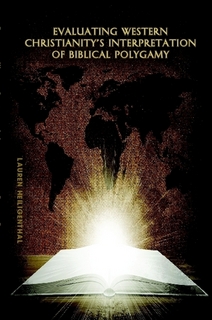
Book Update

My book, Evaluating Western Christianity’s Interpretation of Biblical Polygamy, is officially available on my publisher’s website: http://www.patriarchpublishinghouse.com/9781629045214.htm. A copy is $9.95 plus S&H. If you live outside of the United States, this book can be shipped internationally.

For a summary of this book visit my post Finally Published!

If you’re interested in why I have chosen to write about biblical polygamy, please check out The Story Behind the Book.

If you have any questions, comments, or insights, I’d love to read them and dialogue with you 🙂