To See or Not to See?

I love reading the Book of John. When I was in school, it was kind of a dismissed gospel because it’s not like the other three; however, it is arguably my favorite. From the very beginning it focuses on Jesus’ divinity, His ministry, and His sacrifice. In John 1:17, John writes, “For the Law was given through Moses; grace and truth were realized through Jesus Christ.” How wonderful is that! One of the passages I love the most in John is in chapter 9 where Jesus heals the man who was born blind.

There was a belief that sicknesses, deformities, etc. were a sign of sin. Even Jesus’ disciples ask Him who sinned, the blind man or his parents? Jesus responds by saying that neither had sinned, but the man was born blind so that the works of God might be displayed in him (v. 3). This sets the stage for the rest of passage. The miracle itself is awe-inspiring and demonstrates God’s power, but it’s the interaction between the man and the Pharisees that illustrates the difference between knowledge and wisdom.

The Pharisees are the teachers of the Law. They are the experts who are to lead by spiritual example. Yet with this healed man before them, they cannot reach a consensus on who Jesus is. Many say that Jesus couldn’t be from God because He healed on the Sabbath (v. 16)—something they always like to bring up. When asked about Jesus’ identity, the healed man believes Him to be a prophet (v. 17). Well, the Jews don’t like that so they turn their attention to his parents to find out if their son really was blind. Out of fear of being turned away from the synagogue, his parents throw the attention back to their son—surely he can speak for himself. Repeatedly they ask the healed man how Jesus did it, but he is finished with their interrogation. Instead, he asks, “You do not want to become His disciples too, do you?” (v. 27). Of course not! Instead, they claim to be Moses’ disciples, not followers of this man whose origin remains a mystery to them. Even though they have all the knowledge of the Scriptures, they remain ignorant. On the other hand, the healed man—uneducated and a beggar—understands more of the Scriptures than these experts:

“‘Well here is an amazing thing, that you do not know where He is from, and yet He opened my eyes. We know that God does not hear sinners, but if anyone is God-fearing and does His will, He hears him. Since the beginning of time it has never been heard that anyone opened the eyes of a person born blind. If this man were not from God, He could do nothing.’” (vv. 30-33 NASB)

What a testimony of the greatness of God and the wisdom He gives to those who are willing to receive it! After the man is cast out from the synagogue, Jesus finds him and reveals Himself as the Son of Man. He then uses the healing of the blind man to teach an even greater spiritual message: “’For judgment I came into this world, so that those who do not see may see, and that those who see may become blind’” (v. 39). Of course the Pharisees say, “We are not blind too, are we?” And Jesus replies, “‘If you were blind, you would have no sin, but since you say, ‘We see,’ your sin remains’” (vv. 40-41).

The Pharisees had the truth at their fingertips. Of all the people, they should have known from the beginning who Jesus was. But they got caught up in the letter of the Law instead of its principles. They followed their own understanding and interpretations, and they enjoyed their lofty positions and relationships with the powerful. They neglected the wonderful blessing of truth they were given. They were spiritually blind and remained in sin.

In contrast, the man was a beggar who was born blind with no hope of change until he listened to a man who told him to simply “Go to Siloam and wash” (v. 7). One simple step of obedience changed his life and his testimony. Having heard the truth of the Scriptures, he knew that Jesus could only be from God. He then gained physical and spiritual sight and his sins were forgiven. Simple obedience, simple wisdom, simple truth.

Who are we? Are we like the Pharisees or the healed man? We have heard the truth of the gospel numerous times, yet do we have understanding? We can take theology courses, read a handful of Bible translations and paraphrases, go to church every week, but do we see? Are we aware of our spiritual condition? Do we follow the Lord in simple obedience?

Do not complicate the gospel message. Examine your heart. Talk to the Lord about it. Listen to what He says (for the Lord hears the prayers of God-fearing people who do His will- John 9:31). And do what He says.

May our eyes be opened to His truth.


©Lauren Heiligenthal

Testing the Spirits

I wanted to share a post written by Stacey Louiso, a wonderful Christian woman and author. This post is a challenge to the modern body of Christ, and I think it is quite thought-provoking and biblically sound. Too often the church follows popular leaders and teachings instead of digging deep and testing what’s been preached. Here’s a quote from Stacey’s post:

“Often, as I follow and interact with pastors, ministry leaders and the like on social media, I find myself wishing I weren’t so connected. Some of what fellow Believers proclaim makes me wonder which version/translation of the Bible they read! Why? Their theology, hermeneutics and exegesis are often very loose versions of what the very traditional translations of the Bible contain. Loose (modern) translations of the Holy Bible are part of the very problem described herein, not part of any solution. They often mislead people and lighten the truths of the word of God. Softening the message of the Gospel was never part of God’s plan for Jesus’ sacrifice on the cross, or his resurrection.”

Please check out the rest on her blog: http://www.writingdownlife.com/2017/02/05/a-body-called-to-christ-not-to-a-church-part-1/# . I also encourage you to read other posts she’s written.


The Simple Reason Why I Am Not a Premillennialist

But of that day and hour no one knows, not even the angels of heaven, nor the Son, but the Father alone.  For the coming of the Son of Man will be just like the days of Noah. For as in those days before the flood they were eating and drinking, marrying and giving in marriage, until the day that Noah entered the ark, and they did not understand until the flood came and took them all away; so will the coming of the Son of Man be. Then there will be two men in the field; one will be taken and one will be left. Two women will be grinding at the mill; one will be taken and one will be left.

“Therefore be on the alert, for you do not know which day your Lord is coming. But be sure of this, that if the head of the house had known at what time of the night the thief was coming, he would have been on the alert and would not have allowed his house to be broken into. For this reason you also must be ready; for the Son of Man is coming at an hour when you do not think He will.

“Who then is the faithful and sensible slave whom his master put in charge of his household to give them their food at the proper time? Blessed is that slave whom his master finds so doing when he comes. Truly I say to you that he will put him in charge of all his possessions. But if that evil slave says in his heart, ‘My master is not coming for a long time,’ and begins to beat his fellow slaves and eat and drink with drunkards; the master of that slave will come on a day when he does not expect him and at an hour which he does not know, and will cut him in pieces and assign him a place with the hypocrites; in that place there will be weeping and gnashing of teeth.

~ Matthew 24:36-51 NASB

What is the main point of what Jesus is saying to His disciples? Be ready! No one knows when the Father will have Jesus return. There was a sense of urgency to be on the alert when Jesus was still on the earth, which continued to permeate throughout New Testament teaching and even to this day. My goal with this post is not to pick apart premillennialism, but to simply point out that the teaching regarding seven years of tribulation, where people can have a “second chance” to come to Christ, violates Scripture. Why does it violate Scripture? Because even though people may have missed the first rapture, they will then know that Jesus will return again within seven years. They will have exactly that time to “make things right.” If that’s the case, then why not live like the world now if we are going to get another chance later? Is there really a sense of urgency? Better yet, have we forgotten that we’re living our second chance right now?

Before the Law there was no prescriptive way to be made right before God. This is why Abraham, Isaac, and Jacob are held in high esteem. They had no Law, yet they acted in faith and did instinctively the things that would become Law. God gave Moses and His people the Law in order to set themselves apart and be right with Him. It was rigid and full of regulations. We read it now and wonder how it was even possible to fulfill. That’s the point; it couldn’t be fulfilled. This was the first chance—until Jesus.

Jesus’ sacrifice became the second and ultimate chance. Through His sacrifice we are no longer bound by the rigidity of the Law. We no longer have to offer sacrifices or perform cleansing rituals. We have been baptized with Him and will be resurrected to eternal life because of His grace and mercy. These things cannot be taken lightly, which is why Jesus spends much time talking about being ready and on the alert. Do we want to be like the slave who is found doing what his master desires, or do we want to be like the evil slave who thinks he can do whatever he wants because his master won’t be back for awhile?

A little over seven years ago, I was admonished by close Christian friends (now family) that my spiritual house was not in order. I was encouraged to make myself ready. I have been a Christian since I was seven years old, yet I still needed to be shown that my spiritual life needed a change. Even though we accept Christ and claim to be Christians, we still need to do spiritual cleaning. Just like our actual homes, dust gathers and things that seem gross and terrible at first become part of the norm. There may be an eyesore in our living room, but we wouldn’t notice it because it has become part of our lives. This can also be applied to our spiritual houses. In truth, we can become complacent with behaviors and thoughts that used to convict us, and we may not even realize it until someone else has the right kind of love to point it out. As Paul clearly shares with the Corinthians, we are the temple of the Holy Spirit and should act accordingly:

“Flee immorality. Every other sin that a man commits is outside the body, but the immoral man sins against his own body. Or do you not know that your body is a temple of the Holy Spirit who is in you, whom you have from God, and that you are not your own? For you have been bought with a price: therefore glorify God in your body.” ~ 1 Corinthians 6:18-20 NASB

We have been given a gracious, wonderful second chance at eternal life. Let us do our best to live according to God’s will for our lives and in such a way that others will want to follow God now.


©Lauren Heiligenthal

Sunrise

It has been far too long since I’ve written a post. A big reason is that I’ve felt stuck. Stuck spiritually. Stuck in my career. Stuck in my devotions. Stuck in feeling inspired. It’s difficult to get out of the mud, but I’ve learned that I must pull one leg out at a time and make the effort. The Lord has always been there for me, but He won’t make me move until I’m ready to make that effort. Today is a new day, and I’m excited to be back 🙂 This poem is the best way I know how to share my journey these past few months. I pray that you all are doing well, and that you have a wonderful Christmas! May you always have hope that the sunrise will come.

Sunrise

Flames flicker,

Wisps of smoke;

The air grows cold,

The night remote.

My soul yearns for the light;

It aches for the warmth.

Fear suffocates—

How will I break free

From this insanity?

My reflection is no longer mine

But a stranger who has become me.

I search for the sunrise

Clinging to the hope

That a new day must come.

This fear can no longer encapsulate my heart

And poison my thoughts.

Oh, Light, shine ever bright!

Pierce this darkness!

Awaken my dreams!

I want to see myself again

In You.

~~~

The dawn begins to break;

I search the horizon.

Pink and gold hues cover the sky

As the sun steadily climbs,

Yet greater is the Light in my heart—

The Light of lights who has chosen me

And lifts my spirit above the painted clouds.

He has always been there,

Even in the darkness,

Even when I forget who I am,

He knows and calls me back.

As I search for the way home,

He will not let me forget His dreams for me.

He reminds me that the impossible has been made possible,

That He sustains, provides, and leads.

I must fulfill His call

For this is the only way that I can truly be fulfilled.

Be glorified and magnified, My Savior,

My King!


©Lauren Heiligenthal


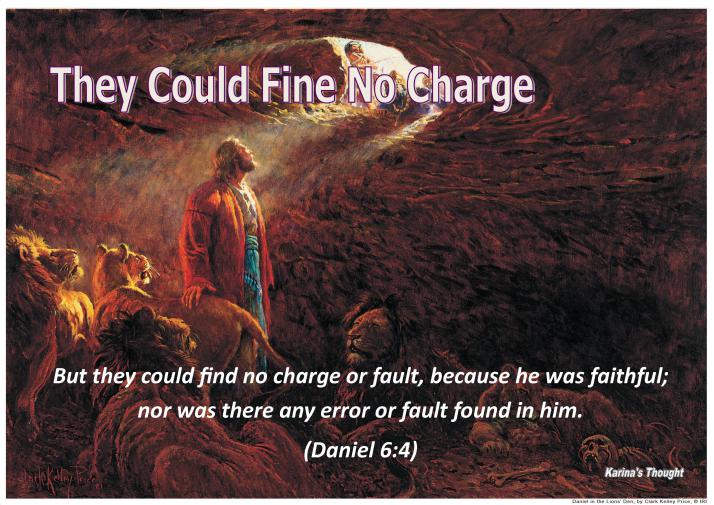
They Could Find No Charge

As Christians we are not guaranteed a problem-free life; rather, Scripture provides many passages that talk about Christians being slandered and persecuted. But how should we respond? Karina Lam has written an excellent post about Daniel’s faith as he faced the lion’s den and how his actions have helped her with a difficult situation of her own. Read and be encouraged that the God’s truth and justice will prevail!

Karina Lam's avatarKarina's Thought

THEY COULD FINE NO CHARGE -Karina's thought

Hello my dear readers, it’s me again with “The Man of faith” series and this post will be the last series. This time I choose Daniel as the last figure. I choose Daniel because coincided with the problem I faced recently. Briefly, please allow me share to all of you.  My problem begins when some time ago, one of our companies won the tender of government’s project. (I am sorry couldn’t mention the country). Turned out this success made envy one of our business competitor then they tried to spoil my reputation by propagates a rumor that in order to win the tender; I gave bribery (In the business world more commonly known as gratification) to some of VIP government officers. To be honest, I am shocked!  Though I really know that the business world sometime is so cruel, I’m still shocked. In my whole life, there’s no one slandering…

View original post 1,634 more words

HE LIGHTS MY WAY

I just love Wendell A. Brown’s writing. His poetry is written from the soul and inspired by Scripture. It encourages me to examine my heart and where I am with God. I hope it encourages you as well. Please check out more poetry from his blog 🙂

Wendell A. Brown's avatarWhere Words Daily Come Alive.com

There are two ways of spreading light.To be the candle or the mirror that reflects it

My heart longs for
You, in the deepest
recesses of an empty
mind

Where there should
be thoughts, where
there should be dreams,

There is no glow.

Your Spirit is far
from me, it has left
me, and I am as an
abandoned child

Should I say that
I need You, but
then You know that

For You know all
things.

Let me have your
spirit with me
to light my way

Let me not do a
displeasing thing
to You whom I love
So wholesomely

But let me live unto
You each and everyday
tasting of Your love,
as You live in me.

(1976)
~~~~~~~~~~~~~~~~~~~~~~~~~~~~~~~~~~~~~~~~~~
Psalm 18:28
For You light my lamp; The LORD my God
illumines my darkness.
~~~~~~~~~~~~~~~~~~~~~~~~~~~~~~~~~~~~~~~~~~
Photo Image Credit,
fabquote.com

.

View original post

Do Not Be Double-Minded

“But if any of you lacks wisdom, let him ask of God, who gives to all generously and without reproach, and it will be given to him. But he must ask in faith without any doubting, for the one who doubts is like the surf of the sea, driven and tossed by the wind. For that man ought not to expect that he will receive anything from the Lord, being a double-minded man, unstable in all his ways.” ~ James 1:5-8 (NASB)

The Word of God is an encourager, a teacher, a guide. It is also an admonisher for the body of believers. Sometimes we want to look past words like “judgment,” or in this case, “double-minded” because we think it’s talking about other people in the world, mainly unbelievers. But the Scriptures weren’t written for the world. They were written for the followers of God (e.g., 1 Cor. 10). Each letter written in the NT was for the church. Within those letters are topics that the church no longer wants to tackle because of our culture’s stance on political correctness. We tread lightly when it comes to homosexuality. We dismiss discussions of theistic evolution. We don’t even dare consider that Scripture talks about the father/husband being the head of the household. We reinterpret Scripture to accommodate the world’s understanding of morality. And we have convinced ourselves that these interpretations are true, or even worse, that we cannot know what truth is.

According to the Greek-English Lexicon of the New Testament: Based on Semantic Domains, to be double-minded (δίψυχος) is to be “uncertain of the truth of something.”[1] In the passage above, James is encouraging the scattered Jewish Christians to not doubt when asking the Lord for wisdom. He equates lack of faith with someone who is double-minded. The Dictionary of Bible Themes describes double-mindedness as being “Indicative of insincerity and hypocrisy. God requires wholeheartedness and sincerity from all people, both in their dealings with others and in their worship of him.”[2] James uses this term again in James 4:

“You adulteresses, do you not know that friendship with the world is hostility toward God? Therefore whoever wishes to be a friend of the world makes himself an enemy of God. Or do you think that the Scripture speaks to no purpose: ‘He jealously desires the Spirit which He has made to dwell in us’? But He gives a greater grace. Therefore it says, ‘God is opposed to the proud, but gives grace to the humble.’ Submit therefore to God. Resist the devil and he will flee from you. Draw near to God and He will draw near to you. Cleanse your hands, you sinners; and purify your hearts, you double-minded.” (vv. 4-8, emphasis added)

Even in the book of Revelation, John is asked to write messages to the seven churches, one of them being Laodicea. In Christ’s words to the church, He describes the believers as being lukewarm:

“‘I know your deeds, that you are neither cold nor hot; I wish that you were cold or hot.  So because you are lukewarm, and neither hot nor cold, I will spit you out of My mouth. Because you say, ‘I am rich, and have become wealthy, and have need of nothing,’ and you do not know that you are wretched and miserable and poor and blind and naked, I advise you to buy from Me gold refined by fire so that you may become rich, and white garments so that you may clothe yourself, and that the shame of your nakedness will not be revealed; and eye salve to anoint your eyes so that you may see. Those whom I love, I reprove and discipline; therefore be zealous and repent. Behold, I stand at the door and knock; if anyone hears My voice and opens the door, I will come in to him and will dine with him, and he with Me. He who overcomes, I will grant to him to sit down with Me on My throne, as I also overcame and sat down with My Father on His throne. He who has an ear, let him hear what the Spirit says to the churches.’”  (Revelation 3:15-22, emphasis added)

James and John (or rather Christ in the context) make it clear that there are two choices: to have faith in God and submit to Him or to doubt God and be friends with the world. It seems straightforward with no room for gray areas.

~~~

So why did Peter, Paul, John, and James write some (what we might think are) harsh words to the church? Were they being judgmental? In a way, yes. Why? Because the church is called to righteousness. Because the church needs discipline. Because we wear the name of Christ.

In 1 Corinthians 5, Paul calls out the Corinthian body of believers because they let sin continue among them. Someone had taken his father’s wife, which was something that Paul had not even heard of among the Gentiles, the non-believers. Paul says to the church, “You have become arrogant and have not mourned instead, so that the one who had done this deed would be removed from your midst” (v. 2). But how can Paul be so harsh? Aren’t we supposed to love and accept people even when they sin? Paul makes his point clear in vv. 9-13:

“I wrote you in my letter not to associate with immoral people; I did not at all mean with the immoral people of this world, or with the covetous and swindlers, or with idolaters, for then you would have to go out of the world. But actually, I wrote to you not to associate with any so-called brother if he is an immoral person, or covetous, or an idolater, or a reviler, or a drunkard, or a swindler—not even to eat with such a one. For what have I to do with judging outsiders? Do you not judge those who are within the church? But those who are outside, God judges. Remove the wicked man from among yourselves.” (emphasis added)

We are all guilty of sinning, but should we willfully continue to sin? The Corinthians knew what was going on, but they said or did nothing. They let it continue, which means that the one who was guilty of such an act was unrepentant. Hebrews 10:26-31 also addresses this issue to Jewish Christians:

“For if we go on sinning willfully after receiving the knowledge of the truth, there no longer remains a sacrifice for sins, but a terrifying expectation of judgment and the fury of a fire which will consume the adversaries. Anyone who has set aside the Law of Moses dies without mercy on the testimony of two or three witnesses. How much severer punishment do you think he will deserve who has trampled under foot the Son of God, and has regarded as unclean the blood of the covenant by which he was sanctified, and has insulted the Spirit of grace? For we know Him who said, ‘Vengeance is Mine, I will repay.’ And again, ‘The Lord will judge His people.’ It is a terrifying thing to fall into the hands of the living God.”

Some people argue that this passage is talking about people who haven’t really accepted Christ. However, to reiterate what I said in the beginning, the NT letters were written to believers. Hebrews is written to a Jewish Christian audience. In verses 19-25 the author (I believe to be Paul) addresses his audience with the inclusive pronoun “we” while talking about holding “fast the confession of our hope without wavering, for He who promised is faithful (v. 23).” He continues to use “we” in the beginning of v. 26 which indicates that he is talking about Christians. The author further clarifies the statement about sinning willfully by adding, “…after receiving the knowledge of the truth…” So we know that the author is talking about Christians who have knowledge of the truth, and yet willfully continue to sin. What is the outcome for such a person? A brief scolding? Give him/her a hug because all we should do is demonstrate acceptance? The text is clear that such a person has regarded the blood of Christ’s sacrifice to be unclean. He/she has spit in Christ’s face along with the gifts of salvation and grace. This person faces a great judgment (vv. 30-31).

We as Christians are held responsible for what we know. The Word of God has been preserved for us. Do we have faith that what it says is true? If we do not understand something, are we willing to ask God in faith for wisdom and knowledge of His truth? And when we ask, are we willing to see the truth even if it may go against our culture or current beliefs? Paul (when he was Saul) had to face the truth that his zeal for God was not acted out in the right way. He believed that persecuting Christians was right because he loved God. But when Jesus appeared to him, Paul found out he was really persecuting God. Peter doubted while walking on water. He denied Jesus three times. He even excluded Gentile Christians for a time having been influenced by other Jews, and he had to be rebuked by Paul. These men confessed their sins and turned away from them. They wrote to the church having experienced hardships themselves. They wrote as fathers/leaders who sought to help their spiritual children bear fruit for God’s kingdom. The path to righteousness takes faith and hard work as we war against our flesh daily. We will stumble at times. We will be tempted and even persecuted. But we have each other for encouragement and admonition. We cannot allow the church to become synonymous with the world no matter how much we might be hated. Instead of being unsure about truth like double-minded people, let us ask God in faith for wisdom and understanding. If we seek Him with all of our hearts, He will be faithful to lead us.


©Lauren Heiligenthal


Footnotes:

[1] Johannes P. Louw and Eugene Albert Nida, Greek-English Lexicon of the New Testament: Based on Semantic Domains (New York: United Bible Societies, 1996), 370.

[2] Martin H. Manser, Dictionary of Bible Themes: The Accessible and Comprehensive Tool for Topical Studies (London: Martin Manser, 2009).
Thank You, Veterans!

On this Memorial Day we remember the men and women who have chosen to serve and fight for freedom. Some have given their lives on the battlefield. Many return home and struggle with the atrocities they have seen and what they have experienced. Their lives have forever been changed. Their families’ lives have changed as they wait for their loved ones to come back. We owe all of them so much for their sacrifice. To all of you who have served or are currently serving in the United States military, thank you! Also, thank you to the families who have sacrificed the comfort of being together for the sake of our freedom and protection. You are not forgotten.


©Lauren Heiligenthal